Tariffs, Turbulence, and Responsible Purchasing: Are Trade Wars More of An Opportunity Than a Threat?

  • Better Buying
  • Responsible Purchasing Practices

Discover how the 2025 Better Buying Purchasing Practices Index reveals new insights on resilience, responsible purchasing, and supplier partnerships amid global trade tensions.

White metal clothing rack with earth toned women's blouses and sweaters
November 25, 2025

The Blessing in Disguise (BiD) Hypothesis encourages us to see challenges as opportunities in disguise and reframe perceived threats as chances for growth, innovation, transformation, and change.

Cascale’s 2025 Better Buying Purchasing Practices Index (BBPPI), published earlier this month, suggests that this may indeed be the case, and that even amid the toughest of geopolitical and trading contexts, brands and supplier companies can work together across the value chain to adopt purchasing practices that ensure fairness, resilience, and shared success.

The Ultimate Stress Test

Data collected for the BBPPI back in 2021 — just as suppliers were emerging, shell-shocked and bruised from the COVID-19 pandemic — revealed some interesting insights. We had expected the scores to take a real beating. But that wasn’t what happened. In fact, the data revealed that companies that had subscribed with Better Buying for two or more rating cycles had continued to improve their purchasing practices, despite the unprecedented shock of COVID.

Buyers who had begun improving their purchasing practices before the pandemic could draw on critical building blocks that helped them weather the storm. They talked to their suppliers. They knew their strengths and weaknesses thanks to the data and insights they had collected through the Better Buying surveys. And they were using that data to partner with their suppliers to co-create solutions to the challenges of COVID, making resilience a joint achievement.

At the time, Better Buying predicted that in the event of any future shocks and disruptions, it would be those companies, with inbuilt business resilience and strong supplier partnerships, that emerged competitively afterwards.

So were we right? Fast forward five years, to the 2025 BBPPI rating cycle, and we see new patterns emerging. Under the BBPPI, we confidentially collected data and insights from suppliers during a period of unprecedented geopolitical tension and uncertainty — much of it stemming from U.S.-imposed tariffs.

A New Kind of Resilience

As in 2021, this new stress-test environment for purchasing exposed weaknesses where resilient practices are not yet institutionalized. The overall industry score was down one point, and most category scores edged lower. This was especially true in the critical area of Planning & Forecasting, down three points from last year — highlighting ongoing challenges in forecast timeliness and accuracy. (Planning & Forecasting is one of seven responsible purchasing practices Better Buying identifies in its ratings cycle). Overall, buyers’ efforts to improve have been limited, and global tensions and tariffs may have further weakened performance.

And yet, as before, that’s not the whole story. Just as we saw during COVID, there are still some buyers – those with stronger processes in place – who have either sustained or improved their performance, indicating that when it comes to responsible purchasing, it’s the quality of buyers’ practices, rather than macro shocks alone, that determines outcomes.

Three Better Buying subscribers in particular were selected for closer analysis this year. Each has participated in the last three BBPPI rating cycles (2023-2025). Not only did they all outperform the soft goods industry average — despite industry-wide declines in almost all purchasing practices categories this year — one company even achieved an impressive 10 percent improvement in its overall score over the period. All three also demonstrated consistent year-on-year performance improvements.

So what did they do right?

One common feature was relatively high performance in Planning and Forecasting — a key driver of decent work, and the category consistently cited by suppliers as the most important area for buyers to focus their improvement efforts. Another was above-the-benchmark performance in relation to sample adoption rates. Suppliers underscored how good practices in these areas enabled them to manage capacity, invest in their workforce, and reduce waste.

Taken individually, each company had particular strengths. Almost all of one company’s suppliers reported that all orders were placed for fully compliant production. Another excelled at providing consistent, predictable monthly order volumes. The third was praised by suppliers for using fair financials, including advance payments and favorable terms.

Transformation Happens Together

These insights prove improvement can be achieved. But for lasting, transformational change, it can’t be just a few companies doing this in isolation. In the seven years since Better Buying began collecting supplier data, the number of participating companies has not grown enough to drive industry-wide change. But Better Buying is now part of Cascale, with 300+ members, presenting a once-in-a-generation opportunity to move the needle.

But how do we make that happen?

One barrier to progress has been fragmented leadership across the value chain. Brand and retailer CEOs must step forward with clear commitments, while suppliers must have meaningful opportunities to shape strategy and show how fairer practices deliver stronger business results.

At a recent panel of C-suite executives from both big brands and leading manufacturers held at Cascale’s Annual Meeting in Hong Kong, calls were made for tangible benchmarks to secure C-suite commitment, and for more opportunities for brand CEOs to actually visit the factory floors and engage directly with manufacturers who make their goods.

It’s highly likely that we will see more tariffs introduced next year, with suppliers facing heightened risks. If we are to survive these urgent threats and realize the opportunities amid the turmoil, CEOs and C-suite executives must recognize and act on the priority role their suppliers play in driving responsible purchasing, as both a mutual business imperative and a shared responsibility across the value chain.


Companies interested in onboarding for the BBPPI 2026 rating cycle should contact Leonie Abraham, Director of Business Development, Better Buying.

Cascale Better Buying Report for SLCP Shows Steady Industry Progress on Audit Harmonization

  • Better Buying
  • Responsible Purchasing Practices

Each year, Cascale Better Buying produces a special report for the Social & Labor Convergence Program (SLCP), capturing year-over-year progress on audit harmonization.

November 17, 2025

Each year, Cascale Better Buying produces a special report for the Social & Labor Convergence Program (SLCP), capturing year-over-year progress on audit harmonization.

In line with previous editions, Better Buying’s 2025 SLCP Win-Win Sustainable Partnership Report offers good news on audit harmonization amid otherwise slow industry progress on purchasing practices overall. An increasing number (92.5 percent, up from 88 percent last year) of suppliers and manufacturers report that buyers are accepting recently completed audits. This is the highest number since Better Buying began collecting data for SLCP, in 2021, an increase of 7 percent in five years. The number of suppliers reporting that their buyers accepted the SLCP Convergence Assessment Framework (CAF) also increased – to 41.5 percent compared to 34.5 percent in 2024. By using available and verified social audits, brands reduce the strain of owned or excessive requests on suppliers.

For some suppliers, this shift translates into tangible savings of up to USD $20,000 per year, with many reporting savings in the range of USD $5,000 to USD $ 10,000. These resources are then reinvested in workplace improvements, worker programs and services, and new technologies that help support more resilient and responsible supply chains.

The analysis is based on data from the Cascale Better Buying Purchasing Practices Index (BBPPI) rating cycle. As part of the Win-Win Sustainable Partnership category, suppliers are asked about the internal alignment of buyers’ corporate social compliance goals and the extent to which buyers contribute to reducing industry-wide audit duplication. The findings are part of the full BBPPI report released last week by Cascale, which tracks performance across seven key purchasing practices categories.

Together, Cascale and SLCP share a longstanding commitment to reducing audit fatigue and improving labor conditions across the industry, by encouraging buyers to accept SLCP data. Audit harmonization is a key component of Cascale’s Decent Work pillar and is identified by manufacturers and suppliers as an important purchasing practice.

Better Buying’s Win-Win Sustainable Partnership Report

  • Better Buying
  • Manufacturing
  • Responsible Purchasing Practices
  • Verification

This Cascale Better Buying report for SLCP showcases how Better Buying data informs a Win-Win Sustainable Partnership, highlighting factors such as audit harmonization. Audit harmonization is a top priority among partners such as Better Buying and the Social & Labor Convergence Program (SLCP).

November 14, 2025

Better Buying Purchasing Practices Index (BBPPI) Report, 2025

  • Better Buying
  • Responsible Purchasing Practices

Purchasing practices performance in Apparel, Footwear and Household Textile Supply Chains.

November 11, 2025

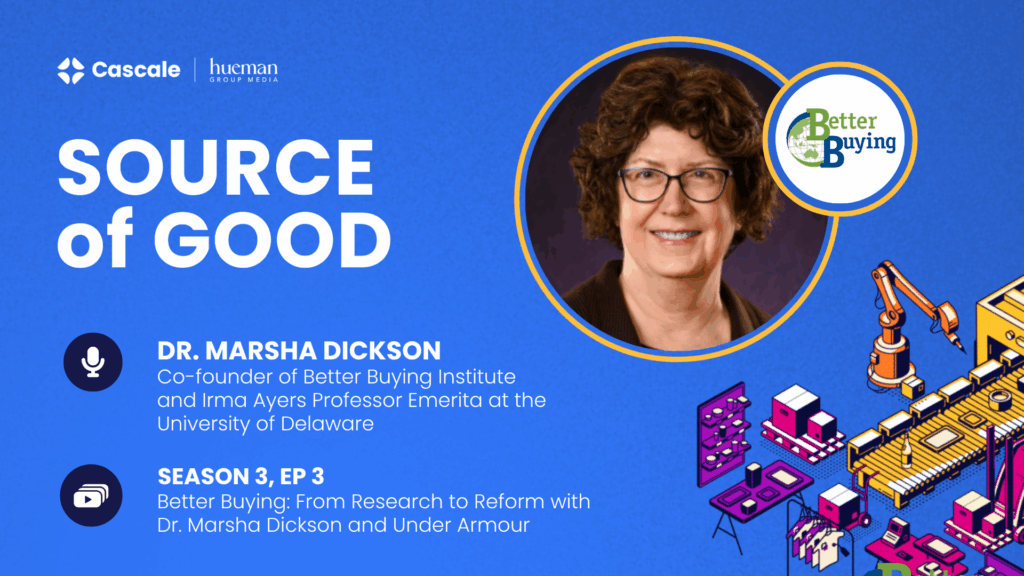
Better Buying: From Research to Reform with Dr. Marsha Dickson and Under Armour

  • Better Buying
  • Decent Work
  • Responsible Purchasing Practices

For more than 30 years, Dr. Marsha Dickson has worked to make fashion more fair. From research and teaching to launching the Better Buying Institute, she’s led the change to center supplier voices and responsible purchasing in the pursuit of decent work. Now, as she steps away from day-to-day leadership and into a much-deserved retirement, Dr. Dickson reflects on what’s changed — and what still needs to be done.

October 29, 2025

Subscribe today on Apple Podcasts, Spotify, or wherever you listen to podcasts

Click here to learn more about Better Buying

Visit Under Armour

– – –

Produced by Cascale and Hueman Group Media. Views and opinions expressed during the podcast are those of the individuals expressing them and do not necessarily reflect those of Cascale or Hueman Group Media.

Transparency Never Goes Out of Style with Retraced

  • Decent Work
  • Responsible Purchasing Practices
  • Transparency

Today, supply chains are more complex than ever.

But that doesn’t mean they have to be difficult to navigate. That’s why our guest, Lukas Puender, co-founded Retraced, an online platform that connects thousands of apparel suppliers and brands and allows them to seamlessly share their supply chain data. More data also means more transparency, a key component of sustainability.

October 14, 2025

Subscribe today on Apple Podcasts, Spotify, or wherever you listen to podcasts

Learn more about Retraced

Check out Marc O’Polo’s sweatshirts here

– – –

Produced by Cascale and Hueman Group Media. Views and opinions expressed during the podcast are those of the individuals expressing them and do not necessarily reflect those of Cascale or Hueman Group Media.

New Cascale Better Buying Partnership Index Survey Opens

  • Better Buying
  • Responsible Purchasing Practices

Cascale Better Buying has opened the fall rating cycle for the Better Buying Partnership Index (BBPI), inviting suppliers and manufacturers to submit feedback to help accelerate responsible purchasing practices across the consumer goods industry.

October 01, 2025

Supplier and manufacturer data is critical to accelerating responsible purchasing practices in the consumer goods industry

Amsterdam, Hong Kong, Oakland (CA) – October 1, 2025: Cascale Better Buying today opened the fall rating cycle for the Better Buying Partnership Index (BBPI), calling on suppliers and manufacturers worldwide to submit feedback to help accelerate responsible purchasing practices across the consumer goods industry. The survey’s unique methodology helps buyers – both Cascale brand and retail members and non-members – better understand how their purchasing practices impact suppliers and manufacturers.

“As a global manufacturer, we firmly believe that the responsibility of improving working conditions and maintaining sustainable practices lies with both buyers and suppliers and manufacturers,” said Michael Cai, Director of Operations & Supply Chain, Décor Global.

“We have been working with Better Buying for over seven years and its vision strongly resonates with us. We see its unique value – providing a safe, confidential platform for suppliers to give candid feedback and co-create solutions. Over the years we have seen positive changes as buyers became more open to our suggestions, with real improvements in forecasting, planning and business management practices. We strongly encourage our peer suppliers to take part and rate their buyers’ purchasing practices.”

Now in its fifth rating cycle, the BBPI is a concise, 12-question, five-minute confidential survey that gathers input into the quality of buyer-supplier relationships. It is aligned with Better Buying’s Five Principles of Responsible Purchasing: time, visibility, stability, fair financials, and shared responsibility, which are reflected in Cascale’s mission to support decent work for all. The BBPI is moving the needle on buyer purchasing practices. Scores for partnership quality have increased every year since the BBPI first launched, with the highest to date, 52, recorded in the last BBPI cycle, a four-point increase from the previous year, reflecting notable improvements in buyer-supplier relationships.

This cycle marks the first BBPI launch since Better Buying joined Cascale earlier this year. All responses are fully anonymized and aggregated, ensuring business relationships are protected and enabling candid, unfiltered feedback. Findings are shared with brands and retailers that subscribe to Cascale Better Buying, equipping them with actionable insights to strengthen purchasing practices. Cascale is encouraging broad participation to strengthen the evidence base, elevate supplier voices, and scale collective progress toward more responsible purchasing.

“Every day, suppliers and manufacturers are impacted by brand and retailer buyer decisions. As such, they are the only true arbiters of where we stand as an industry on responsible purchasing practices,” said Katie Hess, Head of Product at Cascale Better Buying. “To drive transformation at scale, we must expand supplier participation, elevate their voices, and build a robust evidence base. This not only helps brands and retailers improve, but also brings more companies into the journey towards responsible purchasing.”

Through October 31, suppliers and manufacturers can use this link to take the BBPI survey. Brands and retailers, including Cascale members, are also encouraged to share the survey with their suppliers and invite them to rate the quality of their partnership.

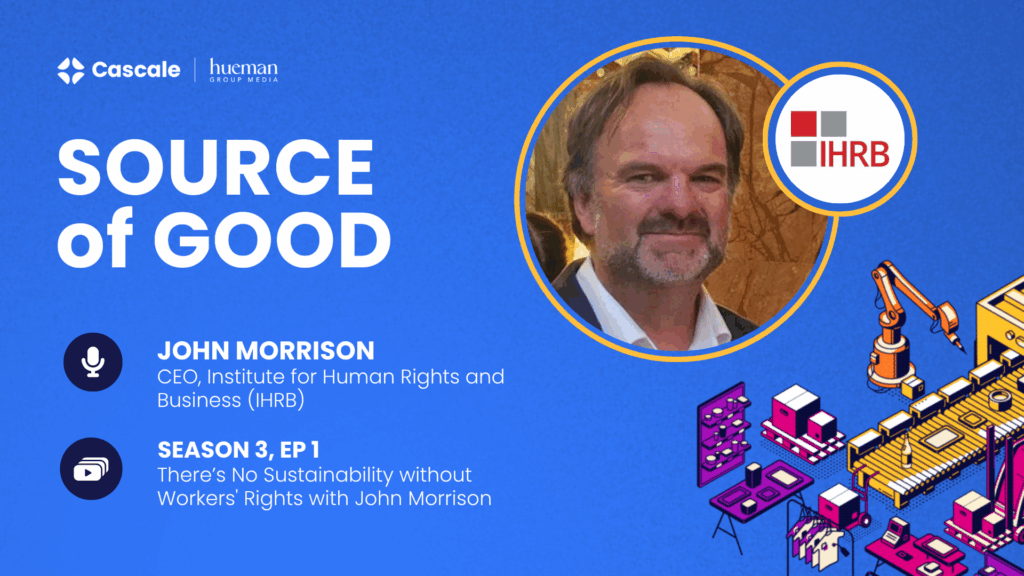
There’s No Sustainability without Workers’ Rights with John Morrison

  • Decent Work
  • Responsible Purchasing Practices

Sustainability isn’t only about climate — it’s also about people. In this episode, John Morrison, CEO of the Institute for Human Rights and Business (IHRB) and author of The Just Transition, explains why workers’ rights must also be at the center of sustainability efforts. He also shares what a “just transition” to a sustainable industry looks like, with measures that ensure no one is left behind.

September 30, 2025

Subscribe today on Apple Podcasts, Spotify, or wherever you listen to podcasts

Learn more about the IHRB at ihrb.org

– – –
Produced by Cascale and Hueman Group Media. Views and opinions expressed during the podcast are those of the individuals expressing them and do not necessarily reflect those of Cascale or Hueman Group Media.

How Cascale, Fair Wear and SLCP Activate Human Rights Due Diligence at the Annual Meeting 2025

  • Annual Meeting
  • Decent Work
  • Partnership and Collaboration
  • Responsible Purchasing Practices

Cascale, Fair Wear, SLCP will dive deeper on creating impactful human rights due diligence at the Annual Meeting 2025.

September 05, 2025

Cascale’s Annual Member Meeting, “A Movement for All,” takes place in Hong Kong September 15 to 17. The event will address how we, as an industry, can collectively address and solve two of the most critical challenges facing our industry today: Combating Climate Change and Supporting Decent Work For All.

It’s an outsized challenge but a shared commitment. Leaders today are those frontrunner brands, suppliers, policymakers, and non-corporate players that are doubling down on climate change and decent work as a business imperative. Together, they are confronting a dizzying array of duplicate initiatives, repeat data sources, and outdated auditing systems in place. By collectively refining the approach to measuring, verifying, and enhancing social and environmental performance, compliance and responsible purchasing practices becomes a nearer reality.

The State of Play 

Compliance is a growing area of interest for industry players, and convening organizations have a role to play. In its background note on regulatory developments concerning due diligence for responsible business conduct, The Role of Sustainability Initiatives in Mandatory Due Diligence (OECD, 2022) recognizes Multi-Stakeholder Initiatives (MSIs) as playing a crucial role, acting as both facilitators, providing tools and guidance for companies, and verifiers, assessing and potentially certifying company practices. But the guidance also notes that, despite recent examples of initiatives converging and aligning approaches, the landscape is still complex and confusing, with 455 ecolabels and various environmental schemes listed in the Ecolabel Index at the time of writing.

In this playing field and true to this year’s event theme, Cascale, the Social and Labor Convergence Program (SLCP), and Fair Wear will come together to be greater than the sum of our already formidable parts to promote impactful Human Rights Due Diligence (HRDD) by brands and suppliers. We aim to support stakeholders on their journey through building and leveraging joint tools, best practices, and accountability mechanisms.

This joint work builds on discussions we originally held at our Annual Meeting in Boston, back in 2023, exploring the potential of HRDD as an organizing principle for the industry, and aims to be complementary – rather than additive. Because it’s only together that can we scale accountability in an actionable way.

Combining Unique Strengths 

Between us, we believe we have all the tools a company needs to conduct impactful due diligence. Cascale owns and develops the Higg Index suite of tools, and since February, has owned the Better Buying toolset informed by surveys on brand and retailer purchasing practices. We have over 300 members and 40,000 Higg Index users. Fair Wear led the industry effort towards alignment on the Common Framework for Responsible Purchasing, while its HRDD Academy supports brands to better understand the HRDD cycle and practically implement human rights due diligence both within the company and across the supply chain. SLCP now boasts over 250 signatories and its Converged Assessment Framework (CAF) forms the foundation of Cascale’s Higg Facility Social & Labor Module (Higg FSLM).

It’s an executive priority. “Cascale, SLCP, and Fair Wear see great opportunities in driving impactful HRDD by working more closely together,” said Harsh Saini, interim chief executive officer of Cascale. “Together, we have immense convening power, expertise, and volumes of credible and actionable data. We are all speaking the same language on due diligence, and our tools fit together and complement each other, providing brands and retailers with everything they need for their due diligence journey.”

As well, the work becomes a shared responsibility. “We’re united around a shared vision,” added Annabel Meurs, executive director of Fair Wear. “This will set the tone in the industry on what impactful due diligence looks like, holding brands and retailers accountable in making progress and to scale up best practices that will have a real impact on workers.”

Steve Harris, COO of SLCP , underscored: “Our three organizations will work together to develop and cross-promote each bilateral partner’s tools, drive collective action, sharing HRDD knowledge and best practice across the whole of our membership and signatories, and advocating for decent work with policymakers.”

The next opportunity to hear more about our collective expression of deepened and more targeted coordination will be at Cascale’s Annual Member Meeting in Hong Kong, September 15 to 17. The event will feature presentations from Fair Wear and SLCP on key topics, including making responsible purchasing practices the norm within the industry, and what needs to happen next to drive real movement on audit fatigue. You can also visit the Cascale, Fair Wear, and SLCP booths in the exhibition area to find out more about the tools and guidance available.

Better Buying Supplier Roundtable Report: Suppliers’ Perspectives on Solutions for Better Costing

  • Responsible Purchasing Practices
August 05, 2025