Cascale Better Buying Responsible Purchasing Practices Snapshot Survey 2025

  • Better Buying
  • Responsible Purchasing Practices

This report offers a data-driven view of how suppliers experience buyers’ purchasing practices across the apparel supply chain. It draws on findings from the fifth annual Better Buying Partnership Index (BBPI) rating cycle and amplifies anonymized supplier feedback to highlight what is working and where improvement is still needed.

Cascale Better Buying Responsible Purchasing Practices Snapshot Survey 2025
January 30, 2026

Inside BBPPI 2025: Better Buying Insights with Innovation Forum

  • Better Buying

Cascale convened industry leaders to explore BBPPI 2025 insights, highlighting shared responsibility between brands and suppliers amid global market volatility.

BBPPI 2025 Webinar Innovation Forum December 2026
December 18, 2025

Cascale recently played a convening role in a jointly produced webinar with Innovation Forum, “Better Buying 2025 Insights: Navigating Global Volatility and Defining the Next Steps for Better Purchasing Practices.”

The December virtual event brought together more than 250 executives and supply chain leaders from across the consumer goods industry to examine how responsible purchasing practices can be strengthened amid ongoing market uncertainty.

Grounded in both data and real-time industry feedback, the webinar underscored the need for shared responsibility between brands and suppliers, and the interdependent roles each plays in planning, sourcing, and purchasing decisions that directly shape environmental and social outcomes.

Diving into Dynamic Insights with Better Buying

To set the stage, Katie Hess, head of product at Cascale’s Better Buying, delivered key insights on the Better Buying Purchasing Practices Index (BBPPI) 2025. The survey is free to complete and maps anonymous supplier feedback across seven key indicators.

Hess highlighted how global pressures — including tariffs and fluctuating demand — are placing significant strain on purchasing processes, with the steepest declines seen in planning and forecasting. Supplier experiences, she noted, vary widely depending on buyer practices, sourcing contexts, and regional dynamics.

She emphasized that BBPPI is not intended as a static benchmark, adding: “When brands actually use the data with their suppliers, behaviors and outcomes change.”

Hess also reinforced communication as a recurring theme across Better Buying surveys, stressing that purchasing practices must be treated as a core business priority, not solely as a CSR initiative.

Unpacking a “State of Confusion” 

Following the data presentation, a panel of experts joined to discuss perspectives on the findings, while identifying areas for improvement.

Speakers included Mobeen Ahmed Chughtai, group head of CSR and corporate communications at Soorty Enterprises Pvt. Ltd.; Naurin Muzaffar, lead advisor sustainability strategy, operations, and transparency at Crescent Bahuman Ltd.; and Susan Scow, sustainability impact specialist at Eileen Fisher, Inc. As moderator, Tanya Richard, chief operating officer and head of stakeholder engagement at Innovation Forum, guided the discussion.

Scow highlighted the value of long-term supplier relationships, noting that Eileen Fisher’s average supplier partnership spans approximately eight years, with some relationships extending beyond 25 years. She shared how Better Buying data can inform product development and logistics decisions — such as shifting freight from air to sea — and pointed to the benefits of supplier-driven initiatives through Cascale’s Manufacturer Climate Action Program (MCAP).

From the supplier perspective, Chughtai spoke candidly about the risks suppliers face when sharing feedback, noting their frequent fear of repercussions for speaking out. He emphasized the importance of suppliers being able to set boundaries and engage in honest dialogue with brand partners.

Muzaffar echoed these challenges, describing a “state of confusion” driven by paused orders and limited visibility that undermines planning. She also raised critical questions around growing regulatory demands and lagging progress on environmental and social goals.

Across perspectives, speakers aligned on the importance of clear communication, trust, and supplier inclusion. The webinar reinforced both the relevance of Better Buying insights and Cascale’s convening power.

Better Buying’s Latest Report: Do We Need a Regional Rethink for Purchasing Practices?

  • Better Buying
  • Responsible Purchasing Practices

During the era of tariffs, BBPPI 2025 data shows repeat subscribers see greater resilience, yet progress is still uneven across a range of criteria. See how supplier regions weigh in.

December 05, 2025

This year’s Better Buying Purchasing Practices Index (BBPPI) collected data from suppliers in the 12 months leading up to April 2025, the latter part of which coincided with the introduction of the U.S. trade tariffs.

The findings reveal notable variations in how suppliers are experiencing purchasing practices across the value chain, portraying uneven progress on responsible purchasing on the part of global brands and retailers.

Regional Findings, At a Glance

Suppliers in North America are struggling to get paid for orders, which is negatively affecting their cash flow and sustainability. But on the plus side, they are reporting better, more accurate and timely forecasts from their suppliers.

In the APAC region, suppliers reported fewer issues with payment and terms but reported weaker design and development practices on the part of their buyer customers. This is in part because of too few samples being converted into orders – wasting valuable time and resources.

These mixed experiences suggest that progress on responsible purchasing is uneven. They are likely due to a combination of factors – they may be as much about the types of product buyers are sourcing and the partnership models they adopt with their suppliers as they are to geography and geopolitical unrest. But they underscore the need for companies to take a more consistent, systems-based approach to improving purchasing practices and embedding fair and predictable working relationships throughout their supply chains.

Understand Supplier Regions, Balance Your Supply Chain

Companies benefit hugely from understanding how suppliers’ experiences of their purchasing practices are shaped by local contexts and business environments, and can learn from higher-performing regions. Thus, they can act accordingly, directing support to those facing persistent challenges for a more balanced and sustainable global supply chain. Those that actively subscribe with Better Buying receive confidential scores and reports, with detailed, granular data specific to their own business, and recommendations as to how they can make improvements, working with their suppliers to co-create solutions to shared business challenges.

Back in 2021, Better Buying collected data from suppliers during the Covid-19 pandemic, and expected to see big falls in the scores awarded to buyers. We were surprised to see that companies that had subscribed with the surveys year over year had still managed to make some improvements, even during this difficult time. The BBPPI data shows that the same is largely true during the era of tariffs. While both the overall and category scores have fallen slightly, those companies that have subscribed with Better Buying year over year have continued to make improvements. Three companies in particular have made big improvements, including one that increased its overall score by 10 points between 2023 and 2025.

Understand Issues Affecting Your Supplier Regions: Act Accordingly

Companies that are serious about human rights due diligence have a platform that enables their suppliers to share their experiences anonymously, giving buyer companies access to deep, granular insights that they can use, in partnership with their suppliers, to build region-specific, targeted strategies for future-proofing their supply chains.

To find out about how to subscribe for the 2026 BBPI, contact Leonie Abraham, vice president of business development, Cascale Better Buying. For a deeper dive on this data, join us for the “Better Buying 2025 Insights: Navigating global volatility and defining the next steps for better purchasing practices” webinar on December 9 with Innovation Forum.

Tariffs, Turbulence, and Responsible Purchasing: Are Trade Wars More of An Opportunity Than a Threat?

  • Better Buying
  • Responsible Purchasing Practices

Discover how the 2025 Better Buying Purchasing Practices Index reveals new insights on resilience, responsible purchasing, and supplier partnerships amid global trade tensions.

White metal clothing rack with earth toned women's blouses and sweaters
November 25, 2025

The Blessing in Disguise (BiD) Hypothesis encourages us to see challenges as opportunities in disguise and reframe perceived threats as chances for growth, innovation, transformation, and change.

Cascale’s 2025 Better Buying Purchasing Practices Index (BBPPI), published earlier this month, suggests that this may indeed be the case, and that even amid the toughest of geopolitical and trading contexts, brands and supplier companies can work together across the value chain to adopt purchasing practices that ensure fairness, resilience, and shared success.

The Ultimate Stress Test

Data collected for the BBPPI back in 2021 — just as suppliers were emerging, shell-shocked and bruised from the COVID-19 pandemic — revealed some interesting insights. We had expected the scores to take a real beating. But that wasn’t what happened. In fact, the data revealed that companies that had subscribed with Better Buying for two or more rating cycles had continued to improve their purchasing practices, despite the unprecedented shock of COVID.

Buyers who had begun improving their purchasing practices before the pandemic could draw on critical building blocks that helped them weather the storm. They talked to their suppliers. They knew their strengths and weaknesses thanks to the data and insights they had collected through the Better Buying surveys. And they were using that data to partner with their suppliers to co-create solutions to the challenges of COVID, making resilience a joint achievement.

At the time, Better Buying predicted that in the event of any future shocks and disruptions, it would be those companies, with inbuilt business resilience and strong supplier partnerships, that emerged competitively afterwards.

So were we right? Fast forward five years, to the 2025 BBPPI rating cycle, and we see new patterns emerging. Under the BBPPI, we confidentially collected data and insights from suppliers during a period of unprecedented geopolitical tension and uncertainty — much of it stemming from U.S.-imposed tariffs.

A New Kind of Resilience

As in 2021, this new stress-test environment for purchasing exposed weaknesses where resilient practices are not yet institutionalized. The overall industry score was down one point, and most category scores edged lower. This was especially true in the critical area of Planning & Forecasting, down three points from last year — highlighting ongoing challenges in forecast timeliness and accuracy. (Planning & Forecasting is one of seven responsible purchasing practices Better Buying identifies in its ratings cycle). Overall, buyers’ efforts to improve have been limited, and global tensions and tariffs may have further weakened performance.

And yet, as before, that’s not the whole story. Just as we saw during COVID, there are still some buyers – those with stronger processes in place – who have either sustained or improved their performance, indicating that when it comes to responsible purchasing, it’s the quality of buyers’ practices, rather than macro shocks alone, that determines outcomes.

Three Better Buying subscribers in particular were selected for closer analysis this year. Each has participated in the last three BBPPI rating cycles (2023-2025). Not only did they all outperform the soft goods industry average — despite industry-wide declines in almost all purchasing practices categories this year — one company even achieved an impressive 10 percent improvement in its overall score over the period. All three also demonstrated consistent year-on-year performance improvements.

So what did they do right?

One common feature was relatively high performance in Planning and Forecasting — a key driver of decent work, and the category consistently cited by suppliers as the most important area for buyers to focus their improvement efforts. Another was above-the-benchmark performance in relation to sample adoption rates. Suppliers underscored how good practices in these areas enabled them to manage capacity, invest in their workforce, and reduce waste.

Taken individually, each company had particular strengths. Almost all of one company’s suppliers reported that all orders were placed for fully compliant production. Another excelled at providing consistent, predictable monthly order volumes. The third was praised by suppliers for using fair financials, including advance payments and favorable terms.

Transformation Happens Together

These insights prove improvement can be achieved. But for lasting, transformational change, it can’t be just a few companies doing this in isolation. In the seven years since Better Buying began collecting supplier data, the number of participating companies has not grown enough to drive industry-wide change. But Better Buying is now part of Cascale, with 300+ members, presenting a once-in-a-generation opportunity to move the needle.

But how do we make that happen?

One barrier to progress has been fragmented leadership across the value chain. Brand and retailer CEOs must step forward with clear commitments, while suppliers must have meaningful opportunities to shape strategy and show how fairer practices deliver stronger business results.

At a recent panel of C-suite executives from both big brands and leading manufacturers held at Cascale’s Annual Meeting in Hong Kong, calls were made for tangible benchmarks to secure C-suite commitment, and for more opportunities for brand CEOs to actually visit the factory floors and engage directly with manufacturers who make their goods.

It’s highly likely that we will see more tariffs introduced next year, with suppliers facing heightened risks. If we are to survive these urgent threats and realize the opportunities amid the turmoil, CEOs and C-suite executives must recognize and act on the priority role their suppliers play in driving responsible purchasing, as both a mutual business imperative and a shared responsibility across the value chain.


Companies interested in onboarding for the BBPPI 2026 rating cycle should contact Leonie Abraham, Director of Business Development, Better Buying.

Cascale Better Buying Report for SLCP Shows Steady Industry Progress on Audit Harmonization

  • Better Buying
  • Responsible Purchasing Practices

Each year, Cascale Better Buying produces a special report for the Social & Labor Convergence Program (SLCP), capturing year-over-year progress on audit harmonization.

November 17, 2025

Each year, Cascale Better Buying produces a special report for the Social & Labor Convergence Program (SLCP), capturing year-over-year progress on audit harmonization.

In line with previous editions, Better Buying’s 2025 SLCP Win-Win Sustainable Partnership Report offers good news on audit harmonization amid otherwise slow industry progress on purchasing practices overall. An increasing number (92.5 percent, up from 88 percent last year) of suppliers and manufacturers report that buyers are accepting recently completed audits. This is the highest number since Better Buying began collecting data for SLCP, in 2021, an increase of 7 percent in five years. The number of suppliers reporting that their buyers accepted the SLCP Convergence Assessment Framework (CAF) also increased – to 41.5 percent compared to 34.5 percent in 2024. By using available and verified social audits, brands reduce the strain of owned or excessive requests on suppliers.

For some suppliers, this shift translates into tangible savings of up to USD $20,000 per year, with many reporting savings in the range of USD $5,000 to USD $ 10,000. These resources are then reinvested in workplace improvements, worker programs and services, and new technologies that help support more resilient and responsible supply chains.

The analysis is based on data from the Cascale Better Buying Purchasing Practices Index (BBPPI) rating cycle. As part of the Win-Win Sustainable Partnership category, suppliers are asked about the internal alignment of buyers’ corporate social compliance goals and the extent to which buyers contribute to reducing industry-wide audit duplication. The findings are part of the full BBPPI report released last week by Cascale, which tracks performance across seven key purchasing practices categories.

Together, Cascale and SLCP share a longstanding commitment to reducing audit fatigue and improving labor conditions across the industry, by encouraging buyers to accept SLCP data. Audit harmonization is a key component of Cascale’s Decent Work pillar and is identified by manufacturers and suppliers as an important purchasing practice.

Better Buying’s Win-Win Sustainable Partnership Report

  • Better Buying
  • Manufacturing
  • Responsible Purchasing Practices
  • Verification

This Cascale Better Buying report for SLCP showcases how Better Buying data informs a Win-Win Sustainable Partnership, highlighting factors such as audit harmonization. Audit harmonization is a top priority among partners such as Better Buying and the Social & Labor Convergence Program (SLCP).

November 14, 2025

Better Buying Purchasing Practices Index (BBPPI) Report, 2025

  • Better Buying
  • Responsible Purchasing Practices

Purchasing practices performance in Apparel, Footwear and Household Textile Supply Chains.

November 11, 2025

Cascale Attends ITMF, IAF Indonesia Conference in October 2025 

  • Better Buying

Cascale attended the joint International Textile Manufacturers Federation (ITMF) and International Apparel Federation (IAF) Conference in Yogyakarta, Indonesia. The event offered a comprehensive look into the future of the textile, footwear, and apparel industries.

Better Buying's Katie Hess participates in the IAF AF Committee Meeting on Purchasing Practices at the IAF and ITMF joint conference in Indonesia.
October 31, 2025

Last week, Cascale’s Katie Hess, head of product, Better Buying, attended the joint International Textile Manufacturers Federation (ITMF) and International Apparel Federation (IAF) Conference in Yogyakarta, Indonesia. The event offered a comprehensive look into the future of the textile, footwear, and apparel industries.

As a critical networking and convening opportunity for suppliers, sourcing experts, and textile stakeholders, the event offered insights into emerging technologies and sustainable practices, as well as highlighting Southeast Asia’s rapidly growing textile market.

Among the attendance were Cascale members and affiliates such as the Apparel and Textile Transformation Initiative (ATTI), and speakers such as independent consultant Olivia Windham-Stewart, Mehmet Kaya (IHKIB – Istanbul Apparel Exporters Association ), and Vidiya Amrit Khan (Brand BGMEA), who are leading their associations’ pioneering roles in the initiative.

Scenes from the IAF ITMF joint conference in October 2025 in Indonesia.

Scenes from the IAF ITMF joint conference in October 2025 in Indonesia.

Elevating Manufacturer Voice, Partnership

Chief above all, the conference reinforced the important role manufacturers play in shaping industry transformation. IAF’s president Cem Altan opened the event with a call for stronger collaboration and equal partnership between manufacturers and brands, noting that suppliers are “very often the starting point for the industry transformation that we need.”

Moving from Audit Fatigue to Audit Convergence

Speakers also unpacked how reducing duplicative audits remains a top priority for suppliers – with progress visible through initiatives such as the Social and Labor Convergence Program (SLCP) and Cascale’s Better Buying. Data from the Better Buying Purchasing Practices Index (BBPPI) 2025 revealed buyer acceptance of SLCP assessments has doubled since 2021, signaling a shift toward more coordinated approaches. Attendees agreed that convergence should serve as a foundation for shared accountability and continuous improvement – not just operational efficiency.

Taking an active role, Cascale also participated in the IAF Committee Meeting on Purchasing Practices and took an all-encompassing factory tour at Indonesian firm Danliris. Established in 1974, the fully-integrated factory serves a growing portfolio of multinational textile and apparel clients.

Scenes from the IAF ITMF joint conference in October 2025 in Indonesia.

Inside the Danliris factory, part of the IAF ITMF joint conference in October 2025 in Indonesia.

Linking Climate Action to Purchasing Practices

Decarbonization emerged as another unifying theme throughout the conference, with panelists from IKEA and Cascale members TAL Apparel and PUMA emphasizing that climate goals are realized through purchasing decisions as much as through technical solutions. Suppliers are already investing in renewable energy and cleaner production, but continued progress depends on commercial models that support and reward those efforts.

This decarbonization panel showcased a range of global initiatives advancing climate action in the apparel and textile sector. Among the mentions was the UN Fashion Industry Charter for Climate Action, represented by Cascale members Matthew Guenther (TAL Apparel) and Stefan Seidel (PUMA).

Be it decarbonization or responsible purchasing practices, participants emphasized the importance of recognizing manufacturers’ leadership on every touchpoint.

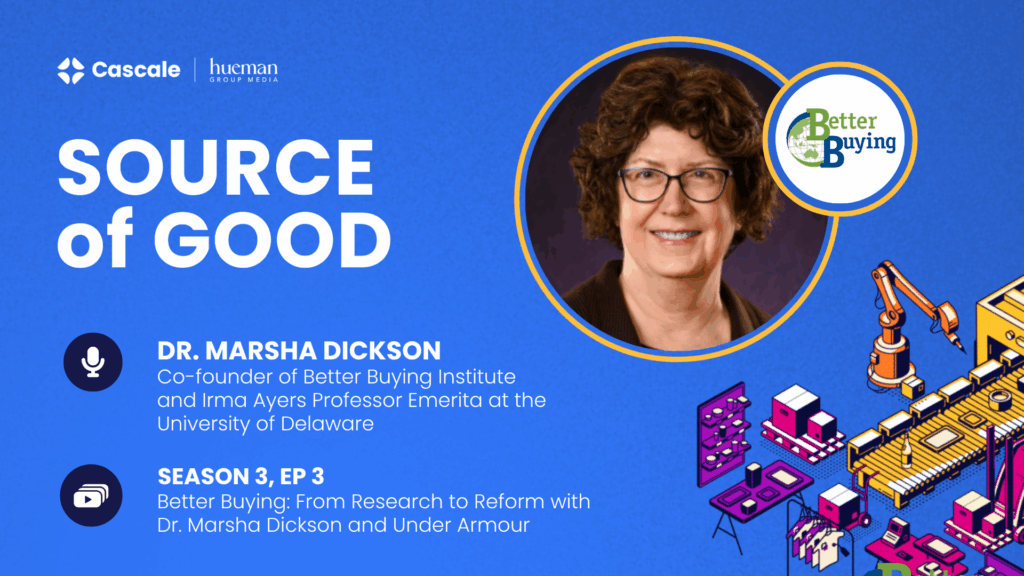
Better Buying: From Research to Reform with Dr. Marsha Dickson and Under Armour

  • Better Buying
  • Decent Work
  • Responsible Purchasing Practices

For more than 30 years, Dr. Marsha Dickson has worked to make fashion more fair. From research and teaching to launching the Better Buying Institute, she’s led the change to center supplier voices and responsible purchasing in the pursuit of decent work. Now, as she steps away from day-to-day leadership and into a much-deserved retirement, Dr. Dickson reflects on what’s changed — and what still needs to be done.

October 29, 2025

Subscribe today on Apple Podcasts, Spotify, or wherever you listen to podcasts

Click here to learn more about Better Buying

Visit Under Armour

– – –

Produced by Cascale and Hueman Group Media. Views and opinions expressed during the podcast are those of the individuals expressing them and do not necessarily reflect those of Cascale or Hueman Group Media.

Guide to Better Buying’s 7 Purchasing Practices for Decent Work

  • Better Buying

Do you know Better Buying’s seven key purchasing practices? Read Lindsay Wright’s latest blog to re-familiarize yourself ahead of the upcoming Better Buying Purchasing Practices Index (BBPPI) report 2025.

An image of green shopping bags cradled in an arm with the text "Guide to Better Buying's 7 Purchasing Practices"
October 22, 2025

Poor purchasing practices place risks on both suppliers and workers, leaving global brands vulnerable to human rights violations in their supply chains. To combat this and help drive responsible purchasing practices across the industry, Cascale’s Better Buying collects anonymous data from suppliers on the purchasing practices of their brands and retailers, and publishes aggregated findings from these surveys twice a year, via two index reports.

Intro to Purchasing Practices, Better Buying

The first report is the Better Buying Partnership Index (BBPI) which Better Buying publishes in February and the second, larger report is the Better Buying Purchasing Practices Index (BBPPI), which we publish in October. For the BBPPI, we focus our reporting efforts on seven key categories that suppliers report are the biggest challenges in providing decent work and wages. These data and insights are fed back to those buyers, highlighting the strengths and weaknesses in their purchasing practices, so they can begin their journey towards improvement.

Ahead of the publication of the BBPPI 2025, here’s a quick breakdown of those seven categories:

  1. Purchasing Practice #1: Planning and Forecasting measures the visibility buyers provide suppliers into ordering plans. This category also measures the accuracy of the buyer company’s planned production with suppliers as compared with the orders they actually place.
  2. Purchasing Practice #2: Design and Development captures the extent buyers are late or inaccurate in providing necessary technical details about products to be sampled or put into production. This category also looks at how often suppliers receive orders for products they develop.
  3. Purchasing Practice #3: Cost and Cost Negotiation captures whether suppliers receive sufficient funds to meet all the buyer’s expectations when production has been completed. This includes costs of all design details and the cost of compensation for workers that meet buyer codes of conduct and legal requirements.
  4. Purchasing Practice #4: Sourcing and Order Placement considers two topics – whether supplier compliance to codes of conduct is incentivized, and how fluctuation affects month to month order volumes.
  5. Purchasing Practice #5: Payment and Terms measures whether suppliers are paid on time and at the price agreed in the contract.
  6. Purchasing Practice #6: Management of the Purchasing Process looks at whether the time suppliers need for production is offered and then maintained during the process of developing products and bringing them to market.
  7. Purchasing Practice #7: Win-Win Sustainable Partnership includes the internal alignment of buyer staff on corporate social compliance goals and the buyer’s contribution to reducing industry-wide audit duplication.

Bonus: Soft Goods Versus Hard Goods

In our Better Buying reports, you will see us reference both soft goods and hard goods. Soft goods are consumer products made from flexible materials, primarily textiles and fabrics, that generally have a shorter lifespan than hard goods. Hard goods encompass durable, non-apparel products that have a slower consumption cycle, such as electronics, furniture, and appliances. Think of hard goods as the opposite of soft goods.

Now that you’ve had your Purchasing Practices 101, we remind you to stay connected and informed for our BBPPI 2025 report coming soon.