Cascale Answers Asia’s Consumer Goods Call for ESG Action

  • Supply Chain

Cascale’s global membership manager, Peony Tam, represented Cascale at two events in Asia focused on advancing sustainability in consumer goods supply chains through collaboration, data, and education.

Cascale's Peony Tam at the Huali Supplier Conference October 2025
November 04, 2025

Last month, Peony Tam, Cascale’s global membership manager, represented Cascale at two events in Asia focused on advancing sustainability in consumer goods supply chains through collaboration, data, and education.

Strengthening Supplier Engagement at Huali Group’s Sustainability Forum

Hosted by Huali Group, one of the world’s largest footwear manufacturers and a key supplier to brands such as Nike and Puma, Tam joined more than 90 strategic material suppliers to discuss the future of sustainable manufacturing.

In her remarks, Tam introduced Cascale and the Higg Index — the industry’s leading suite of tools for measuring environmental and social impact, exclusively available on Worldly — and highlighted Cascale’s role in empowering manufacturers to improve their ESG performance.

She emphasized Cascale’s commitment to combating climate change, aligning closely with Huali’s sustainability priorities, and underscored how Cascale provides guidance, programs, and a platform for manufacturers’ voices to be heard. The session fostered new understanding of how collective data-driven approaches can strengthen transparency and resilience across global supply chains.

Inspiring the Next Generation at Hong Kong Baptist University

In a separate event, Tam returned to her alma mater, Hong Kong Baptist University, as a guest lecturer in the university’s course on corporate social responsibility and stakeholder engagement.

Building on her professional journey from student to sustainability practitioner, Tam spoke to over 40 undergraduate students from the School of Communications, about how Cascale and its partners — including Textile Exchange, ZDHC, and the Apparel Impact Institute — work together to transform the consumer goods industry through the Higg Index tools and capacity-building programs.

During an interactive exercise, students mapped industry stakeholders using Cascale’s membership network, exploring how collaboration among brands, manufacturers, NGOs, and solution providers can drive measurable progress. The session concluded with a call to action, encouraging students to stay engaged in the sustainability field and explore careers that connect purpose with impact.
 

Cascale Releases Higg MSI v3.11: New Cotton Data, Home Materials

  • Transparency

The Higg MSI v3.11 update strengthens data accuracy and transparency across the consumer goods industry.

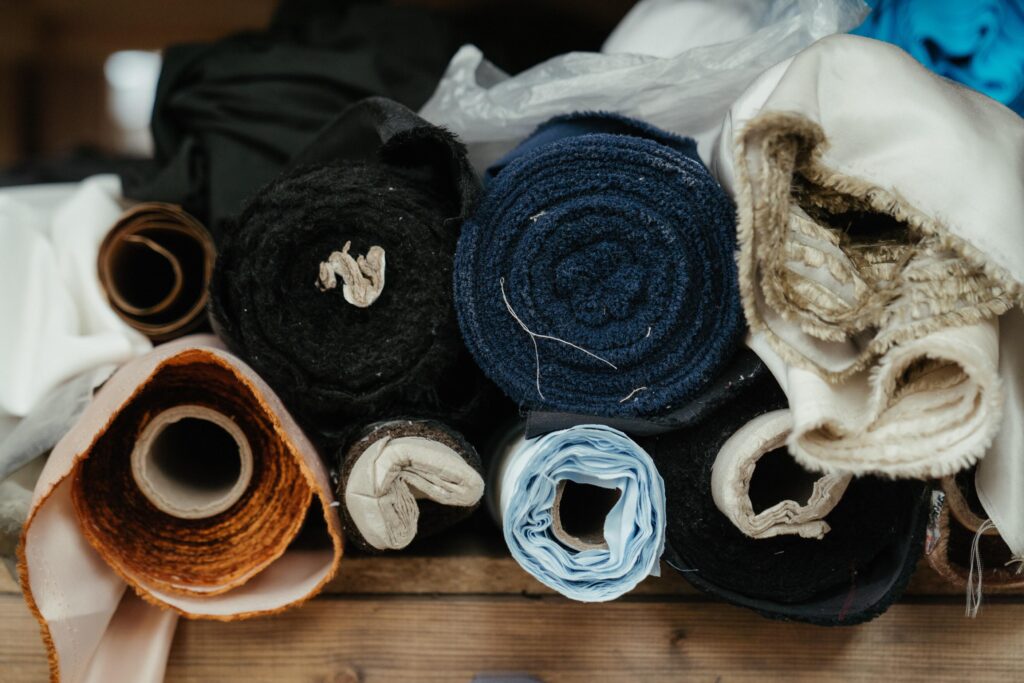
Photo of messily stacked rolls of fabrics
October 29, 2025

Amsterdam, Hong Kong, Oakland (CA) – November 3, 2025: Cascale has released version 3.11 of the Higg Materials Sustainability Index (Higg MSI), introducing new cotton datasets and expanded material categories for home furnishings. The update enhances data accuracy and supports more informed, science-based material choices across the consumer goods industry.

Part of Cascale’s Higg Index suite, the Higg MSI is the industry’s most widely used standardized framework for measuring material impacts – from raw material extraction through manufacturing and finishing. Updated twice yearly, the tool ensures users have access to the most credible, current data available. The Higg MSI is exclusively hosted on Worldly, the leading sustainability data and analytics platform.

“With this update, we’re advancing a more comprehensive, data-driven understanding of material impacts across sectors,” said Jeremy Lardeau, vice president of Higg Index at Cascale. “The improved cotton datasets address a long-standing data gap and represent the power of collective work to strengthen the industry’s access to credible, comparable information.”

New Materials Categories and Updated Datasets

To enhance accuracy and material diversity across the tool, the Higg MSI v3.11 introduces new materials categories that are especially relevant to home furnishing manufacturers, including mineral-based materials such as stoneware, natural stone, glass ceramic, porcelain, and container glass.

“Reliable data is the foundation of responsible sourcing,” said Scarlette Tapp, Scarlette Tapp, Executive Director, Sustainable Furnishings Council, where key assets were acquired by Cascale in September. “Continued evolution of the Higg MSI represents progress toward a stronger value chain for the home furnishings and wider consumer goods industry.”

MSI v3.11 also includes updated modeling for nylon and polyester and expanded data for cotton and leather. Its new cotton datasets were modeled according to Cascale’s industry-aligned Cotton LCA methodology, which was published in October 2024. The cotton methodology was the product of over three years of collaboration between Cascale and key industry stakeholders in order to:

  • Define LCA Data Source requirements to reduce the dependence on costly full LCA reports and landscape existing data collection efforts.
  • Define modeling approaches and clearly document what primary data is required, and what secondary datasets and assumptions are used in the LCA model.
  • Define data use to facilitate better informed design, sourcing and sustainability decisions, and track field practice improvements over time.
  • Consider metrics beyond LCA to complement the Higg MSI LCA data.

“Improving access to farm-level data supports hotspot analysis and can help key stakeholders, especially brand members, in their science-based reporting and evaluation of their selected materials,” said Miguel Gómez-Escolar Viejo, Head of Monitoring, Evaluation and Learning (MEL) at the Better Cotton Initiative. “Working with Cascale to increase data availability following an industry aligned methodology, particularly from smallholder contexts, strengthens collaboration with our brand partners.”

Updated Midpoints and Scores

Additionally, all midpoints and scores were changed to align with the updated LCA for Experts (formerly GaBi) database. Because background datasets such as raw materials and energy were updated, score changes of around ±10% can be expected.

Cascale members and Higg MSI users can learn more about the latest updates by visiting the Higg MSI Change Log.

ABOUT CASCALE

Cascale is the global nonprofit empowering collaboration to drive equitable and restorative business practices in the consumer goods industry. Formerly known as the Sustainable Apparel Coalition, Cascale owns and develops the Higg Index, which is exclusively available on Worldly, the most comprehensive sustainability data and insights platform. Cascale unites over 300 retailers, brands, manufacturers, governments, academics, and NGO/nonprofit affiliates around the globe through one singular vision: To catalyze impact at scale and give back more than we take to the planet and its people.

LinkedIn | Instagram | Facebook | YouTube

Cascale’s Higg FEM Recognized in EFRAG’s New SME Report

  • EU Green Claims

EFRAG highlights Higg FEM among leading platforms supporting SMEs in meeting EU sustainability requirements.

Detail of the facade of the European Parliament 'Paul Henri-Spaak' building via Unsplash.
October 15, 2025

In September, the European Financial Reporting Advisory Group (EFRAG) published its Mapping of Digital Platforms and Initiatives for SME Sustainability Reporting, a comprehensive review of tools helping small and medium-sized enterprises (SMEs) align with EU sustainability requirements, including the new Voluntary Sustainability Reporting Standards for SMEs (VSME).

Out of 223 platforms and initiatives surveyed, Cascale’s Higg Facility Environmental Module (Higg FEM) – available exclusively on the Worldly platform – was highlighted among a small group of platforms shortlisted for deeper review. This recognition underscores Higg FEM’s credibility and strong positioning within Europe’s sustainability reporting ecosystem, particularly the Voluntary Sustainability Reporting Standards for SMEs (VSME).

As EU policymakers explore ways to ease compliance challenges for SMEs, EFRAG’s findings highlight the critical role of industry-developed, data-driven solutions like Higg FEM in delivering practical and scalable pathways for environmental transparency and performance improvement.

Please note that the inclusion of a tool, platform, or initiative in these reports should not be interpreted as a form of direct or indirect endorsement or certification by EFRAG.

Cascale Contributes to Cotton LCA Position Paper

  • Higg MSI
  • LCA

Leading cotton programs have released a joint LCA position paper raising awareness on data use and misconceptions, with Cascale contributing additional expertise.

A close-up image of a cotton boll.
October 09, 2025

In the latest effort to make cotton data more accessible and available, cotton programs have released an LCA position paper, with Cascale contributing additional expertise.

Together, Better Cotton, Cotton Australia, Cotton Incorporated, and U.S. Cotton Trust Protocol commissioned the report, with Cascale, Cotton Research and Development Corporation, and Textile Exchange as contributors. EarthShift Global, LLC prepared the report, “From Data to Impact: How to Get Cotton LCAs Right” which zeroes in on the importance of proper use and interpretation of cotton LCA data, especially in the context of differing growing regions and methodological parameters.

Cascale’s Joël Mertens, head of Higg Product Tools at Cascale, outlined the problem. “What can I really claim in terms of making change happen?” It is one thing to say, “This is my footprint,” and another to claim that switching from cotton to another fiber or blend has helped improve climate change or water scarcity. This last piece in particular is the one that is misleading. The approach that moves the sector forward is fixing the supply change instead of ignoring the problem by going somewhere else without moving the state of play.”

The work followed a joint workstream within Cascale: the Higg MSI Methodology Cotton Expert Team, to help collaboratively address cotton data gaps. The 40-page report captures a number of nuances, challenges, and positive indicators for change, hoping to help guide sustainability managers, policymakers, cotton programs, and growers.

”Real progress will come from investment in farmer-centered improvements backed by science and transparency, aligning around responsible use of LCAs,” read a line from the report’s summary.

Readers can find the report and press release on Better Cotton’s website.

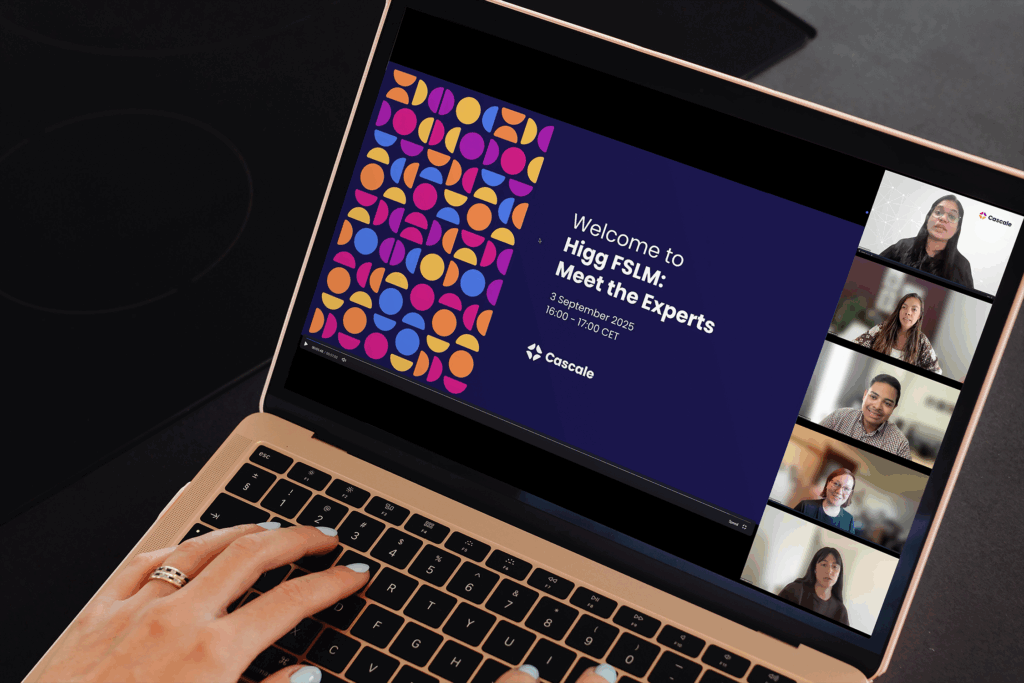
Cascale Hosts “Higg FSLM: Meet the Experts” Member Webinar

Members joined in a collaborative conversation with experts from Cascale, SLCP, and Worldly to deepen understanding of the Higg FSLM and its impact

September 08, 2025

Members joined in a collaborative conversation with experts from Cascale, SLCP, and Worldly to deepen understanding of the Higg FSLM and its impact.

On September 3, Cascale welcomed more than 50 brand & retailer members and stakeholders to an exclusive Q&A webinar, Higg FSLM: Meet the Experts. The session offered a unique opportunity for members to engage directly with the experts behind the Higg Facility Social & Labor Module (Higg FSLM), part of the Higg Index suite of tools. The Higg Index — owned and developed by Cascale, and exclusively available on Worldly — helps brands, retailers, and manufacturers understand and improve performance across environmental and social impact areas, and the Higg FSLM specifically focuses on measuring and improving social and labor conditions in global supply chains.

The webinar was hosted by Hamza Habib Hasan, senior membership engagement manager for brand & retailer membership at Cascale, and featured presentations from:

  • Orine Dsouza, senior manager, Higg Facility Tools, Cascale
  • Laura Jans, customer growth manager, SLCP
  • Camille Stripoli, stakeholder engagement & partnerships manager, SLCP
  • Leah Jaggars, senior manager, customer education, Worldly

Together, they explained how the Higg FSLM is powered by a tripartite collaboration:

  • SLCP develops and maintains the Converged Assessment Framework (CAF), the foundation of the Higg FSLM, to collect and verify social and labor data with the goal of reducing audit fatigue.
  • Cascale integrates the CAF into the Higg FSLM, providing the scoring methodology and benchmarking tools that drive continuous improvement.
  • Worldly hosts the technology platform that makes it possible to complete the Higg FSLM and enables supply chain collaboration.

Experts shared how the Higg FSLM’s standardized scoring methodologies support facilities and brands to identify and prioritize risk more effectively. Dsouza also highlighted how tool developments are accelerated through the work of Cascale’s Member Expert Teams (METs) and Strategic Councils — governance bodies that bring together member perspectives to ensure industry alignment and practical usability of the tools.

This was followed by a deep dive into the SLCP CAF, which emphasized SLCP’s ongoing commitment to aligning the framework with human rights due diligence (HRDD) requirements. Members also heard updates on data availability, with CAF now accessible in 122 countries and regions, and were directed to key resources from all three organizations to support adoption and use.

The event concluded with a candid Q&A session, where members clarified the methodology, gained a deeper understanding of the scoring system, and shared feedback with the organizations leading this work.

This webinar reflects Cascale’s ongoing commitment to support members with opportunities to connect directly with experts, gain clarity on industry-leading tools like the Higg FSLM, and share feedback that helps shape future developments. By creating spaces for education and dialogue, Cascale strengthens member capacity to adopt solutions that reduce duplication, improve data quality, and accelerate progress on social and labor priorities.

Cascale members may access the session recording and summary on Cascale Connect here.

FLAG Emissions Report

  • Science-Based Targets

Cascale and Worldly have released the “Navigating Forest, Land, and Agriculture (FLAG) Emissions” report to offer a standardized method for estimating FLAG emissions for the apparel and footwear industry.

August 14, 2025

Forest, Land, and Agriculture (FLAG) Emissions Responsible for 22 Percent of all Global GHGs in 2019

What’s Inside the Report:

  • Data insights using Cascale’s Higg Index tools, exclusively available on Worldly

  • Key guidance for companies to assess the relevance of FLAG emissions to their organizations

  • Foundational framework designed to help companies take initial steps in FLAG emission estimations using consistent, sector-relevant methods

Higg FSLM CAF v1.7 Webinar

A public webinar focused on the Higg Facility Social & Labor Module (Higg FSLM) CAF v1.7 updates.

Date & Time
April 10 2025 | 10:00 - 11:00 (CEST)

Higg BRM 2024 Webinar

A member-only webinar focused on the Higg Brand & Retail Module (Higg BRM) 2024 update and its transformative potential for sustainable change.

Date & Time
February 20 2025 | 10:00 - 11:00 (CEST)

2024 Reflections: Celebrating Progress, Demanding More

CEO Colin Browne reflects on his first seven months at Cascale and what needs to happen next!

Cascale CEO and 2024 end of year reflections
December 23, 2024

As we close the book on 2024, I want to start by celebrating the progress we’ve made together.

This year, Cascale underwent a transformational rebrand that better reflects who we are and what we stand for: collective action at scale. Our Annual Meeting in Munich set a new benchmark for engagement, aligning members around the critical challenges of our time.

We’ve made strides in policy work, collaborating with partners to amplify the industry’s voice on regulations that matter. We’ve enhanced tools like the Higg Index, ensuring they’re fit for purpose and aligned with the evolving needs of our members. We’ve also begun working more strategically with key partners, and we’ve seen incredible commitment from across our community to tackle the twin crises of climate change and social inequality.

There’s so much to be proud of.

But this isn’t one of those end-of-year posts where I pat us on the back and say, “job well done.” Because, let’s be honest: it’s not enough. Not by a long shot.

Earlier this week, I spoke with a colleague in the industry who mentioned that it often takes a year for outsiders to feel comfortable within the nonprofit sector. But if “getting comfortable” means accepting the current state of affairs, then I refuse to do so. In the words of American activist and author Angela Davis, “I am no longer accepting the things I cannot change. I am changing the things I cannot accept.”

The question for me—and for all of us whose work ties back to the consumer goods value chain—is this: What can we no longer accept?

What I Can No Longer Accept

First, the endless cycle of audits. I recently met with a manufacturer whose supply chain endured 723 audits in a single year. This staggering number represents wasted time, money, and resources—resources that could be invested in improving working conditions or reducing environmental impacts.

We’ve talked for years about harmonizing audits, yet duplicative proprietary demands persist. It’s time for brands to step up and commit to meaningful, long-term partnerships with their facilities. Responsible purchasing practices can no longer be optional.

My commitment: In 2025, Cascale will double down on harmonizing frameworks and fostering equitable business practices that enable decent work. And, we hope to have some big news on the horizon.

Second, the patchwork of science-based targets (SBTs). Instead of supporting their supply chains in setting meaningful decarbonization goals, too many brands are pushing this responsibility onto manufacturers, creating conflicting and burdensome requirements.

My commitment: Cascale will leverage its convening power to drive systemic action through the Industry Decarbonization Roadmap (IDR), catalyzing progress on energy transitions, foundational environmental performance, and supply chain decarbonization.

Third, the lack of shared responsibility for critical investments. Brands and manufacturers must work together to fund the solutions we need to build a resilient, sustainable supply chain. Collaboration is a two-way street, and we need you to engage and collaborate with intent.

My commitment: Cascale will continue to lead pre-competitive collaboration, creating the conditions for impactful partnerships that drive measurable progress.

Moving Beyond the Status Quo

Angela Davis’s words resonate deeply: accepting the status quo is not an option. Regulation is inevitable, but so are the worsening impacts of climate change and inequality. Our industry must lead, not react.

I’m increasingly hearing that some companies are walking back their climate action plans, choosing to focus solely on compliance. They claim they can’t afford to do both. Not only is this staggeringly irresponsible, but it’s also shortsighted. Legislation will soon demand we demonstrate measurable progress—not just promises. And let’s not forget: consumers are watching. They will call out companies that fail to act, and the reputational cost of inaction will far outweigh any short-term savings.

At Cascale, we’re ready to roll up our sleeves and get to work. But this isn’t something we can do alone. Collaboration isn’t just a buzzword—it’s the only way forward. This isn’t about maintaining the status quo. It’s about reimagining what’s possible and aligning our efforts to create the impact our planet and people so desperately need.

So, as you take time to recharge over the holidays, reflect on the progress we’ve made, but also on the work that lies ahead. Come January, let’s dive deeper, push harder, and go further—together.

Thank you for your unwavering commitment and passion. Let’s make 2025 a year of bold action and tangible impact.

Cascale, SLCP, and Worldly Co-Host Webinar on Higg FSLM to Support Social Compliance

  • Higg BRM
  • Policy and Legislation
Two people in a factory, wearing helmets. Machinery is visible in the background.
November 21, 2024

On November 6, Cascale, the Social & Labor Convergence Program (SLCP), and Worldly, the leading sustainability data insights platform, co-hosted the latest webinar in the Navigating Legislation & the Higg Index series, titled “Higg FSLM in Supporting Social Compliance.”

The webinar brought together industry experts to explore the evolving regulatory landscape and how Cascale’s Higg Facility Social Labor Module (Higg FSLM) based on the SLCP’s Converged Assessment Framework (CAF) can help companies navigate social compliance obligations.

This webinar, the third in the series, focused on the intersection of social compliance and legislative frameworks that impact supply chain management. Gabriele Ballero, public affairs manager at Cascale, moderated the session, which featured insights from Elisabeth von Reitzenstein, senior director of public affairs at Cascale; Orine Dsouza, senior manager, Higg Facility Tools at Cascale; Tom Mason, senior policy & stakeholder engagement manager at SLCP; and Vic Lau, customer success manager at Worldly.

The session attracted a diverse audience of sustainability specialists, ESG managers, compliance officers, and other professionals eager to understand how the Higg FSLM (based on  SLCP’s CAF)  aligns with emerging global regulations. Attendees engaged in a discussion on how the Higg FSLM  can support compliance with regulations designed to improve human rights and forced labor standards in global supply chains.

Key Insights from the Webinar:

During the webinar, von Reitzenstein provided an overview of the rapidly evolving EU and U.S. regulations, such as the EU CS3D, the German Supply Chain Act, and the U.S. Uyghur Forced Labor Prevention Act. She highlighted the growing importance of Human Rights Due Diligence (HRDD) and how these regulations are shaping the future of supply chain transparency and accountability.

Dsouza outlined the Higg FSLM, which is based on SLCP’s CAF. The tool offers a standardized, data-driven approach to assessing social and labor compliance in manufacturing facilities. Dsouza explained that the tool helps manufacturers reduce audit fatigue, easily compare data, and allocate resources more effectively for continuous improvement.

Mason discussed how SLCP is mapping the CAF against evolving legislation and emphasized the importance of aligning social compliance tools with regulatory requirements. Mason also highlighted SLCP’s HRDD Toolkit, which supports companies in understanding how the CAF can help them to meet compliance obligations, and previewed updates to the CAF slated for Q1 2025 to enhance policy alignment.

Lau demonstrated how Worldly’s platform hosts Cascale’s Higg Index suite of tools, including the Higg FSLM, and how they have made assessment results more user-friendly. Lau explained how the platform’s summaries and scoring features enable companies to track their progress year over year to support users in improving social and labor conditions and reducing audit fatigue for supply chain facilities.

Also, during the webinar, von Reitzenstein announced a strengthened partnership between Cascale and SLCP. Together, they have developed a joint public affairs vision statement to align efforts in policy and advocacy. This collaboration ensures that tools like SLCP’s CAF and Higg FSLM are effectively integrated into social policy frameworks, driving global improvements in labor standards and ethical practices within the industry.

The Higg FSLM, supported by the strategic collaboration between Cascale, SLCP, and Worldly, will continue to evolve to meet the needs of companies navigating regulatory requirements. Cascale’s Navigating Legislation & the Higg Index webinar series will continue into 2025, offering more in-depth discussions on how the Higg Index tools can support compliance with new and emerging legislation.

To stay informed about upcoming webinars and the latest updates from Cascale, be sure to subscribe to our newsletter.