
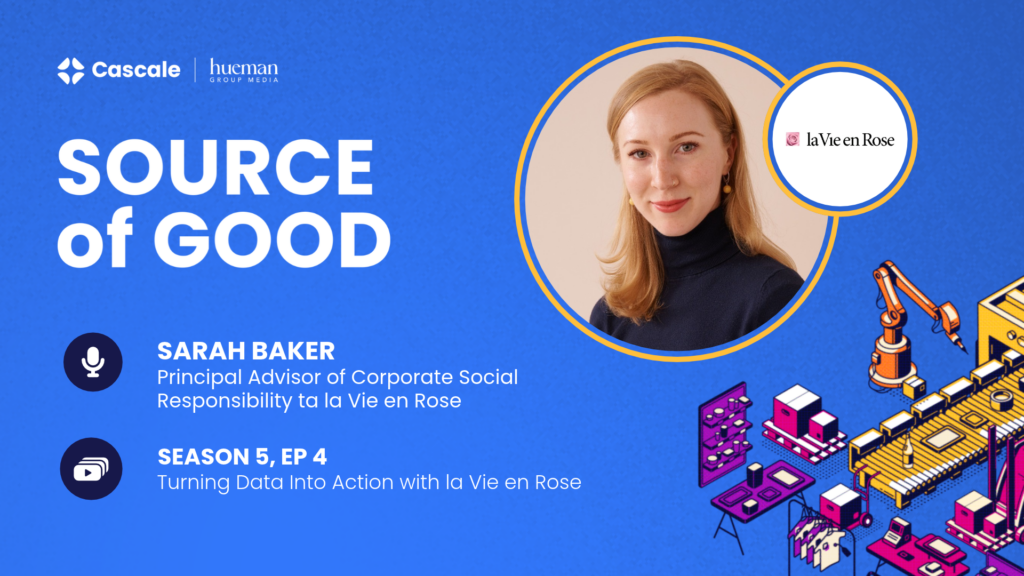
Turning Data Into Action with la Vie en Rose
Sarah Baker, Principal Advisor of Corporate Social Responsibility at la Vie en Rose, joins us for season 5, episode 4 of our Source of Good podcast.
October 21, 2026
New EU regulations will soon require Digital Product Passports (DPPs) for certain apparel products sold in the EU, but Nanna Ingemann Dalsgaard sees them as far more than a compliance checkbox. In this episode, she explains how a simple QR code or hidden chip embedded in a garment could reshape supply chain transparency, customer engagement, and the future of how we shop.
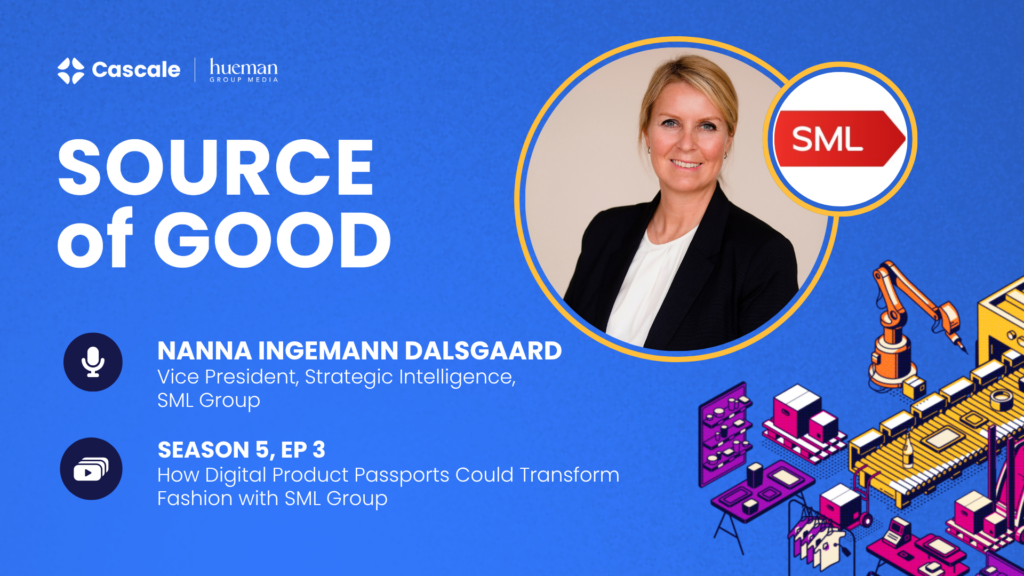
Please note: Since recording this episode, Nanna Ingemann Dalsgaard’s role at SML Group has changed to Vice President, Strategic Intelligence at SML Group.
NOTE: Digital Product Passport requirements for textiles and apparel under the EU Ecodesign for Sustainable Products Regulation (ESPR) are still under development. The textile-specific requirements, including the detailed DPP requirements, will be defined through the relevant product-specific delegated act. Regulatory references in this conversation therefore reflect the status at the time of recording.
To learn more about SML, visit sml.com
Check out our previous episode about Digital Product Passports with Nobody’s Child
Produced by Cascale and Hueman Group Media.
Views and opinions expressed during the podcast are those of the individuals expressing them and do not necessarily reflect those of Cascale or Hueman Group Media.
Cascale’s “Source of Good” Season 5 returns with H&M Group, Cascale, and more executives discussing sustainability in consumer goods.
Amsterdam, Hong Kong, Oakland (CA) – September 2, 2026: Cascale today announced Season 5 of its “Source of Good” podcast, which continues to bring together leaders from across the global consumer goods industry to explore how collaboration, credible data, and practical action can accelerate progress to combat climate change and support decent work for all.
Across the season, “Source of Good” will examine the interconnected challenges facing consumer goods companies and the opportunities for collective action across the value chain. Conversations will highlight how manufacturers, brands, retailers, investors, and other industry stakeholders are building new approaches to climate action, responsible business practices, supply chain resilience, and sustainability performance.
“Source of Good is about creating a space for honest conversations about what it takes to turn sustainability ambition into action,” said Ying McGuire, Cascale CEO, who kicks off the season on September 8. “By bringing together perspectives from across the value chain, we can learn from one another, challenge ourselves, and identify practical approaches that can help move the industry forward.”
The season continues Cascale’s focus on creating space for candid, practical conversations about what is working, where challenges remain, and what it will take to accelerate progress across the industry.
“We cannot look at sustainability — either if it is decarbonization or other sustainability topics — we can’t look at them as something that’s happening on the side. We’re seeing the world changing in so many different ways and faster than ever before,” said Hampus Starre Friberg, head of sustainability, strategy, and controlling, H&M Group, in an episode that airs September 22.
“Source of Good” is a co-production of award-winning production company Hueman Group Media and Cascale. It reflects Cascale’s role as a convener, bringing together diverse perspectives to help the consumer goods industry tackle challenges that no company can solve alone. By sharing experiences, lessons learned, and practical approaches, the podcast aims to help listeners understand not only what needs to change, but how change can happen.
Listen to Season 5 of “Source of Good” on major podcast platforms and access episodes at https://lnk.to/sourceofgood.
——
ABOUT CASCALE
Cascale is the global nonprofit industry alliance where consumer goods organizations turn shared sustainability ambitions into measurable progress at scale to combat climate change and support decent work for all. We unite 300 Corporate and Affiliate members in pre-competitive collaboration, turning shared measurement and collective action into reduced risk, stronger credibility, and long-term resilience. Our work is anchored by Cascale’s stewardship of the Higg Index frameworks (accessed through the Worldly compliance and sustainability platform), along with the Better Buying and Sustainable Furnishings Council tools.
“Source of Good” explored consumer goods policy alignment, supply chain leadership, the financial reality of sustainability, and more in Season 4.

Cascale has wrapped Season 4 of its member-focused podcast, “Source of Good,” concluding a ten-episode run that aired from March through August 2026 and featured executive voices from across the global consumer goods value chain.
Co-produced with Hueman Group Media and hosted by Cascale senior communications director Rachel Lincoln Sarnoff, the season featured Cascale members including Levi Strauss & Co., Busana Apparel Group, Komar, TAL Apparel Limited, SanMar, Coats, MAS Holdings, Stretchline, and Gokaldas Exports, alongside industry stakeholders such as The Policy Hub.
Across ten episodes, guests offered perspectives on some of the most pressing sustainability challenges and opportunities facing the consumer goods value chain — from navigating evolving EU policy and embedding sustainability into business strategy to decarbonizing manufacturing, strengthening purchasing practices, improving environmental performance, and investing for the long term.
This season concluded on August 4 with Siva Ganapathi, vice chairman and managing director at Gokaldas Exports. Ganapathi reflected on the manufacturer’s transformation, including investments in renewable energy, water efficiency, waste reduction, and technology, and why sustainability has become part of the company’s strategy for long-term growth.
“If we do that, it’s not just that we’re doing good for the community, which we should be. We’ll also be able to get a business head start, as those who don’t invest in these areas may not be the long-term players. It made environmental sense, it made social sense, and it made business sense,” said Ganapathi.
Key Takeaways, Season 4
Taken together, the conversations highlighted a common theme throughout Season 4: meaningful sustainability progress depends on long-term investment, credible data, and greater collaboration across the value chain.
“Source of Good” is one way Cascale elevates the expertise and leadership within its membership to a broader industry audience. Across podcasts, case studies, news, blogs, social media, and other storytelling opportunities, Cascale creates avenues for members to share progress, surface practical solutions, and contribute their perspectives to the conversations shaping the industry.
All episodes of “Source of Good” Season 4 are available to stream on Cascale’s Podcast Hub and major podcast streaming platforms.
In this guest blog, Jayanth Kashyap, investment lead at Good Fashion Fund, outlines the industry’s structural gaps and how Cascale’s “Source of Good” podcast dives deeper.


Key Takeaways
The conversations that stay with me aren’t the ones about ambition. They’re the ones about friction. A small-to-medium-sized textile mill owner in Bangladesh who can’t access a long-term loan because their balance sheet doesn’t fit a bank’s credit model. A brand sustainability team that has committed to Scope 3 targets but can’t finance the transition for their Tier 2 suppliers. A policymaker designing carbon incentives without a clear picture of what manufacturers can absorb.
These aren’t isolated problems. They are symptoms of the same structural gap: capital, data, policy, and production are moving on separate tracks, at different speeds, with different incentives.
That’s the problem “Source of Good” takes seriously. It’s why I was glad to be part of the conversation in Season 3, and why I am excited to dive into Season 4, which launched this week. Good Fashion Fund works at this intersection, moving affordable capital to SME manufacturers in South and Southeast Asia who are ready to decarbonize but locked out of conventional finance and locked into high carbon assets. What we have found is that the technical and financial solutions largely exist. The harder problem is alignment, and brands have a real role to play here, not just as buyers setting sustainability requirements, but as co-investors in the transition. When brands, capital providers, and manufacturers are pulling in the same direction, individual deals stop being one-offs and start becoming a scalable model.
“Source of Good” doesn’t treat these as parallel conversations. And that’s because the link between supply chain due diligence, procurement decisions, and investment flows isn’t incidental. It’s structural, and none of it holds if workers aren’t part of the conversation. Inclusive progress isn’t a downstream outcome but a condition for the transition to be durable at all. Ultimately, this won’t be driven by any single actor getting it right. It will happen when enough actors stop optimizing in isolation.
Nine episodes explore decent work, supplier engagement, and how industry tools can support shared progress on climate change.

Cascale has wrapped Season 3 of its “Source of Good” podcast, a nine-episode season that featured industry leaders working to advance decent work and climate action across the consumer goods supply chain.
With a thematic focus on the people and practices behind sustainability, the season explored what it takes to protect workers’ rights, strengthen human rights due diligence, improve purchasing practices, and build resilient, fair supply chains. Each episode offered a holistic lens on how collaborative actions directly support efforts to combat climate change.
Season 3 also explored how industry-aligned tools and shared frameworks can help translate commitments into action — supporting common expectations, more consistent supplier engagement, and progress that can be measured over time. The season referenced Cascale’s Higg Index tools, exclusively available on Worldly, and Better Buying surveys, which Cascale acquired in 2025, as examples of how standardized data, benchmarking, and supplier feedback can help organizations align efforts across the value chain.
This season brought together experts spanning human rights, responsible purchasing, transparency, investment, circularity, and supplier engagement — featuring conversations with leaders from the Institute for Human Rights and Business (IHRB), Retraced, UNIQLO, Fair Wear, Good Fashion Fund, REI Co-op, ERALDA, and more.
Episodes included:
“Source of Good” is a co-production of award-winning producer Hueman Group Media and Cascale, a global nonprofit alliance empowering collaboration to drive equitable and restorative business practices in the consumer goods industry. The podcast is hosted by Rachel Lincoln Sarnoff, Cascale’s communications director and a former journalist.
Since its debut in September 2024, “Source of Good” has released nearly 30 episodes featuring industry experts and leaders working across climate action, transparency, circularity, and decent work. Guests to date have included author and Cascale co-founder Rick Ridgeway, as well as leaders from organizations such as Recover, Brooks Running, Lenzing, Sappi, Dunelm, Nobody’s Child, the Apparel Impact Institute (Aii), PrimaLoft, Tapestry, ITL, Ren Energy, Hirdaramani, Elevate Textiles, Avery Dennison, Cotton Incorporated, Hanesbrands, and many more.
Cascale’s “Source of Good” will return for Season 4 in spring 2026, with more conversations on collective action across the consumer goods supply chain to combat climate change and support decent work for all. Episodes are available on multiple platforms, including Apple Podcasts, Spotify, iHeart Radio, Amazon Music, and more. Listen and subscribe.
Sarah Baker, Principal Advisor of Corporate Social Responsibility at la Vie en Rose, joins us for season 5, episode 4 of our Source of Good podcast.
Nanna Ingemann Dalsgaard, Vice President, Strategic Intelligence at SML Group, joins us for season 5, episode 3 of our Source of Good podcast.
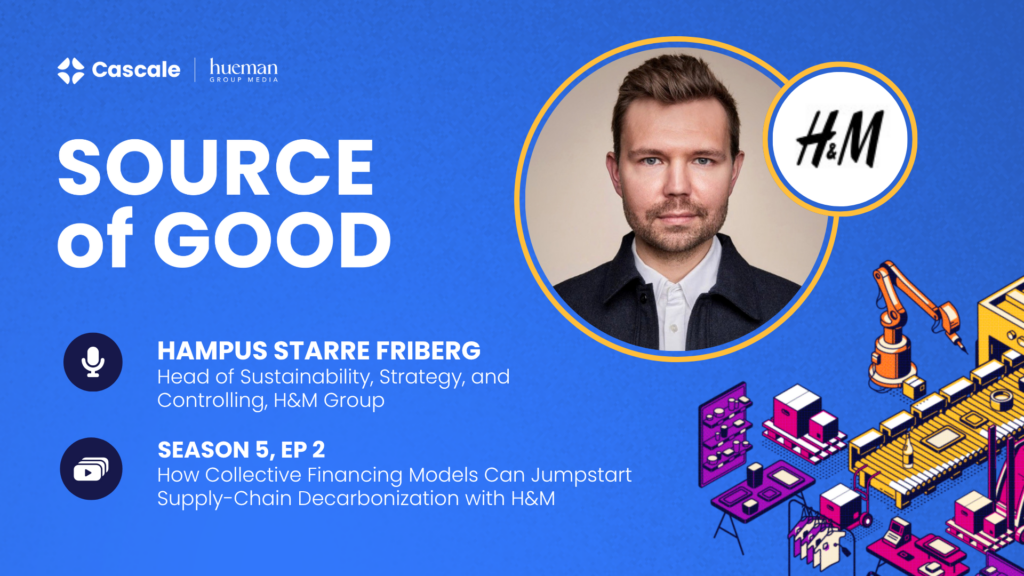
Hampus Starre Friberg, Head of Sustainability, Strategy, and Controlling at H&M Group, joins us for season 5, episode 2 of our Source of Good podcast.
Cascale has wrapped Season 2 of its Source of Good podcast, highlighting industry leaders driving supply chain transformation and collective climate action.

10-episode series highlights industry leaders sharing practical solutions for supply chain transformation and collective climate action
Cascale has wrapped Season 2 of its Source of Good podcast, a ten-episode series amplifying industry voices driving decarbonization across the consumer goods sector. Accelerating supply chain transformation and empowering collective action to combat climate change is critical to Cascale’s mission, targeting a 45 percent reduction by 2030, in line with the 1.5°C pathway.
This season explored renewable energy, supplier engagement, material innovation, and manufacturer practices – showcasing experts from manufacturers, brands, and service providers, including the Apparel Impact Institute (Aii), Tapestry, Cotton Incorporated, Hanesbrands, Elevate Textiles, Avery Dennison, ITL, Primaloft, Hirdaramani, and Ren Energy.
Episodes included:
Source of Good is a co-production of award-winning producer Hueman Group Media and Cascale, a global nonprofit alliance empowering collaboration to drive equitable and restorative business practices in the consumer goods industry.
Source of Good is available on multiple platforms, including Apple Podcasts, Spotify, iHeart Radio, Amazon Music, and more.

“Source of Good” interviews experts – including Lewis Perkins of Aii – on sustainable transformation to a low-carbon economy.
Amsterdam, Hong Kong, Oakland (CA) – April 22, 2025: With a thematic focus on consumer goods supply chain decarbonization, the new season of Cascale’s “Source of Good” podcast reflects the nonprofit organization’s commitment to combat climate change. Kicking off with Lewis Perkins of Apparel Impact Institute (Aii), released today, “Source of Good” will share actionable insights and inspiring stories that drive the urgent transformation needed in the consumer goods industry. Across 10 bi-weekly, 20-minute episodes, listeners will discover how innovative companies – including Tapestry, Primaloft, ITL, and more – use Cascale’s Higg Index tools and other pioneering practices with the aim to achieve a 45% reduction in GHG emissions by 2030, ultimately aligning with a 1.5°C future.
“Our work with Cascale is about more than metrics – it’s about building momentum for real, lasting change,” said Lewis Perkins, president at Aii. “Together, we’re shaping a shared roadmap to help our industry cut emissions. I’m inspired by what’s possible when we align around bold action and collective responsibility for a better industry and healthier planet.”
Building on the inaugural season successes – including a conversation with Rick Ridgeway, legendary mountaineer, environmentalist, writer, and Cascale co-founder – “Source of Good” set the standard for industry dialogue on sustainable practices. With subscribers in over 50 countries, listeners can find the podcast on all major streaming platforms and follow the journey of industry change through each insightful episode.
“By spotlighting supply chain decarbonization, we’re addressing one of today’s most urgent challenges—while sharing powerful stories of transformation. These episodes showcase tangible strategies that inspire collective action and demonstrate how our industry can unite for a sustainable future,” said Lee Green, vice president of Marketing & Communications at Cascale.
“Source of Good” is produced by Hueman Group Media, a Webby-winning media company that produces high-caliber podcasts for social change and impact. The show is hosted by Rachel Lincoln Sarnoff, Cascale’s communications director and a former journalist. “Source of Good” is available on multiple platforms, including Apple Podcasts, Spotify, iHeart Radio, Amazon Music, and more.
For more information about Cascale and to listen to the Source of Good podcast, visit cascale.org/resources/podcast/ or join our email mailing list.
Revisit Source of Good Season 1
Andrew Xeni, founder & chairman of Nobody’s Child and founder & CEO of Fabacus, joins us for season 1, episode 10 of our Source of Good podcast.
Jean Hegedus, Director Of Sustainability at The LYCRA Company, joins us for season 1, episode 9 of our Source of Good podcast.
Lisa Ly, Senior Sustainability Manager at Dunelm, one of the UK’s largest home furnishings retailers, joins us for season 1, episode 8 of our Source of Good podcast.

Did you know that eucalyptus trees grow more than six feet in a single year? It’s true! And it’s one of the reasons Sappi Verve uses them to make its dissolving pulp, which is transformed into viscose and other products. On today’s episode, Krelyne Andrew, Sappi Verve’s General Manager of Sustainability, explains the many benefits of eucalyptus trees and the company’s other responsible practices.

The timeless style Eileen Fisher is known for isn’t just a product of its creative design. It’s also linked to the brand’s sustainable sourcing and practices. In this episode, Susan Scow, Sustainability Specialist at Eileen Fisher, breaks down the steps to produce one iconic piece.
Trees are more than just bark, branches, and leaves. They contain a secret ingredient that is critical to a more sustainable fashion industry. In this episode, Thomas Matiz, Product Sustainability Specialist at Lenzing Group, takes us into a fairy tale world where responsibly managed forests become fabric. Except, it’s not magic. It’s science.
What if a quick scan of a QR code could answer every question you had about a product? At the women’s clothing brand Nobody’s Child, they’ve implemented that very technology. It’s all part of a revolution in the way consumers interact with products. At the helm is Andrew Xeni, founder & chairman of Nobody’s Child, founder & CEO of Fabacus, and our guest today.

Subscribe today on Apple Podcasts, Spotify, or your favorite platform to hear how brands and manufacturers are tackling sustainability, one product at a time.
To learn more about Nobody’s Child visit nobodyschild.com
To learn more about Fabacus, visit fabacus.com
– – –
Produced by Cascale and Hueman Group Media.
Views and opinions expressed during the podcast are those of the individuals expressing them and do not necessarily reflect those of Cascale or Hueman Group Media.
For more than 60 years, LYCRA® has kept us comfortable with its iconic stretch fabric. But now, the manufacturer is reinventing its material with an unexpected ingredient: corn. Yes, corn! In this episode, Jean Hegedus, Director Of Sustainability at The LYCRA Company, explains how using dent corn can yield a more sustainable, bio-derived version of their legendary material—without sacrificing performance or comfort.

Rachel Lincoln Sarnoff: For millennia, humans have worn clothes that change or enhance their body shape. Think of the bronze Spartan breastplate with its fake six-pack or the Victorian whalebone corset and its painfully tiny waist. These items were worn for very different reasons, but what they did have in common was how incredibly uncomfortable they were.
Jean Hegedus: Back in the fifties, you know, women, when they would wear foundation garments at that time, they were made with rubber and so they were really hot and heavy and very uncomfortable.
RLS: That’s Jean Hegedus, sustainability specialist for the LYCRA Company.
JH: LYCRA® was actually invented as a replacement for rubber. That’s what the scientist, Joseph Shivers, was looking for, and so he invented this very lightweight fiber that could provide both stretch and support to garments and to make them a lot more comfortable. So the name actually came from like rubber.
RLS: That was in 1958. Suddenly, foundation garments – or as we now call them, shapewear – became far more comfortable than our ancestors could ever have dreamed. And it wasn’t long before LYCRA® — which is also referred to as Spandex and Elastane — was being used to make other clothing, too.
JH: LYCRA® is in almost everything, whether you’re talking about intimate apparel or swimwear or activewear, socks, hosiery, knit tops, t-shirts, jeans…
RLS: The material is ubiquitous – and it’s now being re-invented for the sake of sustainability, with the help of a truly unusual ingredient.
Subscribe today on Apple Podcasts, Spotify, or your favorite platform to hear how brands and manufacturers are tackling sustainability, one product at a time.
To learn more about The LYCRA Company’s sustainability initiatives, visit www.lycra.com/sustainability
Check out a pair of Lululemon yoga pants made from LYCRA® at www.lululemon.com
– – –
Produced by Cascale and Hueman Group Media.
Views and opinions expressed during the podcast are those of the individuals expressing them and do not necessarily reflect those of Cascale or Hueman Group Media.
Would you throw away a whole sofa because of one stain? Sometimes, we have to, but those giant pieces of furniture wreak havoc on landfills. That’s why Dunelm designed its Full Circle Sofa with modular pieces that can be swapped out, repaired, and even recycled. Lisa Ly, Senior Sustainability Manager at Dunelm, one of the UK’s largest home furnishings retailers, explains this and other groundbreaking initiatives in its “Good and Circular” approach.

Rachel Lincoln Sarnoff: 800 years ago, in the city of Leicester, England, a market opened just south of the clock town. It was the kind of place where you could buy almost anything—food, clothes, flowers, and, eventually, home goods.
Lisa Ly: Dunelm started in 1979 as a market store in Leicester Market and was founded by Bill and Jean Adlai. They invested in ready-made curtains and a seconds curtains, bedding, and slippers. So seconds is basically where it’s a run-off or the end of production products that others might not want to sell. And they bought them and sold them on the market.
RLS: That’s Lisa Ly, senior sustainability manager at Dunelm, which today is one of the UK’s most trusted brands for homeware and furniture.
LL: So, Dunelm is, in fact, the name of a house where Bill, Jean, and the family lived. We used to be called Dunelm Mill, and the “mill” comes from the history of textiles, but we dropped the “mill.” But you still hear our customers call us Dunelm Mill, which is quite unique.
RLS: Some old habits take a long time to break. And in fact, there’s a lot of value in longevity. In today’s episode, we’ll get an in-house look at how Dunelm prolongs their furniture’s lifespan through a groundbreaking approach to circularity…
To learn more about Dunelm, visit www.dunelm.com.
Check out Dunelm’s line of Full Circle Sofas here.
Subscribe today on Apple Podcasts, Spotify, or your favorite platform to hear how brands and manufacturers are tackling sustainability, one product at a time.
– – –
Produced by Cascale and Hueman Group Media.
Views and opinions expressed during the podcast are those of the individuals expressing them and do not necessarily reflect those of Cascale or Hueman Group Media.
