Cascale Publishes Q3 2024 Global Legislative Update: New Worker Protections, Sustainability, and Climate Regulations

  • Policy and Legislation
Stack of knitted winter sweaters on wooden background
October 09, 2024

Cascale, the global nonprofit alliance formerly known as the Sustainable Apparel Coalition, has published its third Global Legislative Update for its members.

The comprehensive quarterly report offers a thorough overview of legislative actions from July to September 2024 affecting the textile and apparel industry across the EU, U.S., Asia, and other key markets. With over 300 leading organizations, Cascale recognizes the importance of staying informed on policy shifts to support sustainable practices and navigate evolving regulations.

The latest update highlights significant regulatory advancements focused on worker protections, environmental sustainability, and climate-related disclosures, with key developments in regions like the U.S., EU, and Asia. These updates emphasize stricter compliance requirements across the industry, particularly in addressing climate change and promoting responsible supply chains.

Below is a summary of key insights from the Q3 Global Legislative Update, offering a glimpse of the full report. The full report is available exclusively to Cascale members on our members-only platform, Cascale Connect. Cascale members are encouraged to log in to access the latest Global Legislative Update.

Key Developments

  • Several regulatory developments designed to protect workers came into play. For example, the United States proposed its first-ever rule to protect workers from extreme heat, while Indonesia passed a new law strengthening the rights of working mothers.
  • Environmentally and socially responsible supply chains gained momentum around the globe. Mainland China, India, and the United States have made strides toward adopting measures that promote more sustainable product practices. In the EU, the Ecodesign for Sustainable Products Regulation (ESPR) and the Corporate Sustainability Due Diligence Directive (CS3D) entered into force – on July 18 and July 25, respectively.
  • In the EU, newly re-elected European Commission President Ursula von der Leyen presented a set of ‘Political Guidelines’ for her second term of office. The guidelines include a commitment to staying the course on the goals set out in the European Green Deal. The guidelines will inform the Commission’s legislative agenda over the next five years.
  • In the United States, California passed an amendment granting a six-month extension to the California Air Resources Board (CARB) to finish its rulemaking and adopt regulations for reporting entities’ annual greenhouse gas (GHG) emissions disclosures under the state’s 2023 climate disclosure laws. The amendment does not alter the compliance deadline, which starts in 2026 for large private and public companies doing business in the state. California also signed into law the Responsible Textile Recovery Act (SB 707), introducing an extended producer responsibility (EPR) program for waste apparel and textile articles from 2028.
  • The United Nations Climate Change Conference, or Conference of Parties (COP) presidency, currently held by Azerbaijan, announced plans for what it hopes to achieve at the COP29 in Baku this November. A key agenda priority is the creation of a climate fund, capitalized with voluntary contributions from fossil fuel-producing countries and companies. Global climate adaptation finance remains insufficient.

Key Implications

  • Recent worker-related regulatory developments worldwide signify an overall strengthening of protection of employee wellbeing and introduce additional compliance requirements for companies across industries. For example, employers may need to designate a ‘heat safety officer.’
  • The EU’s ESPR aims to reduce the negative impact of products throughout their lifecycle. The use of life cycle assessment (LCA) data is central to ecodesign and the ESPR. Product-related sustainability data will be registered in the Digital Product Passport (DPP), a key component of ESPR. This includes data on its materials, manufacturing processes, end-of-life options, and environmental impact. The textile, apparel, footwear, and consumer goods sectors, with their often complex and lengthy supply chains, are expected to be significantly affected by ESPR. Complementary to the Regulation itself, a Delegated Act for Textiles is currently being developed, which will lay down the detailed components of how the regulation is to be implemented for the apparel and textiles sector.
  • The European Commission’s ‘Political Guidelines’ introduce new initiatives, such as the Circular Economy Act and Clean Industrial Deal, which could be relevant to Cascale’s impact pillar ‘combating climate change.’ Other initiatives, including a European Water Resilience Strategy, a chemicals industry package, and a Vision for Agriculture and Food, may have indirect impacts on environmental sustainability and resource efficiency.
  • California’s two climate disclosure laws go beyond the U.S. Securities and Exchange Commission (SEC)’s draft climate disclosure rule (currently on hold pending court challenges) and most public companies’ current practices, particularly in reporting Scope 3 emissions. Given the size of California’s market, the state often acts as a ‘de facto’ national regulator. Harmonized legislative frameworks would be preferable for many companies and are also a key policy priority for Cascale members.

In the next few weeks, Cascale and Worldly will publish a deep-dive analysis of the latest developments and implications of the recent California climate laws. Join our mailing list and make sure this new deep-dive is delivered straight to your inbox when it’s released.

Looking Ahead

  • Demands for better protection for workers in the context of climate change will increase, especially in light of the International Labour Organization’s (ILO) recent warning that over 70% of the global workforce is at risk of extreme heat. Industries reliant on manual labor are at the highest risk.
  • As climate’s overall impact on health comes into greater focus, governments will likely seek to offload some of the economic cost onto the private sector.
  • In the EU, while the new Commissioner has indicated a continuation of climate policy, climate change could become less of a priority following the European Parliament’s shift to the right in the June elections. Climate action will increasingly be framed in the context of industrial competitiveness.
  • The outcome of the U.S. presidential election in November could significantly influence the pace of the country’s — and the world’s — green energy transition. Vice President and Democratic nominee Kamala Harris’ energy policy position includes support for the energy transition and international agreements on climate change, coupled with increased environmental regulation. The energy policies of former President and Republican nominee Donald Trump would focus on the deregulation of the fossil fuels sector.
  •  A Harris administration could potentially strengthen the U.S.‘s commitment to international climate agreements, such as the Paris Agreement, which would have significant implications for fashion’s carbon footprint. A re-election of Trump to the presidency would likely lead to U.S. disengagement from climate negotiations, potentially hampering global efforts to mitigate climate change.

Cascale’s Public Affairs team is committed to keeping members updated on critical legislative developments and their potential impacts. These updates align with Cascale’s strategic plan and policy priorities and are designed to address the most pressing needs of our members. For more detailed insights and resources, Cascale members can access exclusive content via Cascale Connect here.

Stay Informed

Cascale will host a Brand & Retail Forum in Brussels, Belgium, on December 4-5, 2024. The event offers a dynamic mix of policy-focused discussions and broader industry insights, all designed to empower Cascale members and stakeholders in the consumer goods sectors. Learn more and register today.

For the latest Cascale updates, events, and public affairs activities, subscribe to our newsletter.

Not yet a Cascale member? Explore membership today.

Cascale, Worldly, Release Deep Dive on EU’s Corporate Sustainability Due Diligence Directive (CS3D)

  • Legislation and Policy

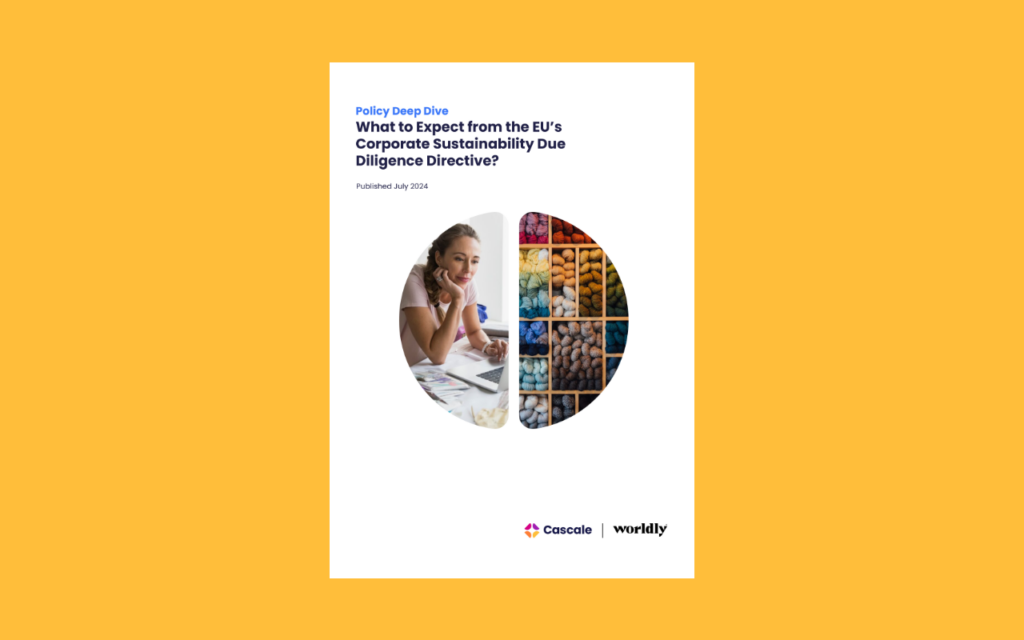
Cascale, formerly the Sustainable Apparel Coalition, and Worldly, the planet’s most comprehensive sustainability data and insights platform, have published a deep dive paper analyzing the European Union’s (EU) Corporate Sustainability Due Diligence Directive (CS3D).

July 15, 2024

Cascale, formerly the Sustainable Apparel Coalition, and Worldly, the planet’s most comprehensive sustainability data and insights platform, have published a deep dive paper analyzing the European Union’s (EU) Corporate Sustainability Due Diligence Directive (CS3D).

This comprehensive analysis provides a detailed overview of the directive’s implications for businesses, especially within the textile, apparel, footwear, and wider consumer goods sectors.

The CS3D, adopted by the Council of the EU on May 24, 2024, and published in the EU Official Journal on June 13, marks a significant milestone in the EU’s efforts to enhance human rights and environmental due diligence. The directive requires large companies to identify, prevent, and mitigate adverse human rights and environmental impacts associated with their operations, which would set a new international benchmark for responsible business conduct.

Key highlights from the paper:

  1. Dynamics of National Transposition: The deep dive provides an overview of how major EU markets, including Germany, France, and the Netherlands, are progressing with the transposition of the CS3D into their national laws. The analysis covers the unique challenges each country faces and potential obstacles that could impact the timely and effective implementation of the directive.
  2. Implications for the Industry: The paper outlines the specific requirements and obligations for brands and retailers in the consumer goods sector, emphasizing the importance of developing robust due diligence programs and data collection on environmental and social performance.
  3. Tools for Compliance: To support businesses in meeting the CS3D requirements, Cascale and Worldly highlight the use of the Higg Index tools. These tools, continually updated through the organizations’ deep collaboration, are designed to help companies measure and track their sustainability performance. With recent tool updates, the Higg Index tools are evolving to further align with global frameworks and enhance data accuracy for regulatory reporting.

Businesses, stakeholders, and industry professionals can explore Cascale and Worldly’s deep dive paper to better understand the implications of CS3D on their businesses and how to prepare for its implementation. The paper provides valuable insights to help companies transition towards more responsible and sustainable business practices.

Read the full deep dive paper here.

The adoption of the CS3D is a significant step towards enhancing corporate sustainability and accountability within the EU. With detailed analysis and practical guidance, Cascale and Worldly aim to support Cascale members and Higg Index users in navigating this regulatory change and driving positive social and environmental impacts.

Sustainability and Regulation: Highlights from Cascale’s Latest Global Legislative Update

  • Legislation and Policy
July 04, 2024

Cascale, formerly the Sustainable Apparel Coalition, has released its second Global Legislative Update to members.

The comprehensive quarterly report provides a detailed overview of legislative activities affecting the textile and apparel industry, as well as the broader consumer goods sector, across the EU, U.S., Asia, and other key markets. As a global nonprofit alliance with over 300 leading organizations, Cascale understands the crucial role of staying informed about policy changes to support sustainable practices and navigate evolving regulations.

Below is a summary offering a sneak peek into Cascale’s Global Legislative Update. The full document is available exclusively to Cascale members through Cascale Connect, a members-only platform. Cascale members can click here to access the full report.

Key Developments

From April to June 2024, significant legislative progress was made in areas such as climate change, labor rights, and promoting a nature-positive future.

  • Major elections took place across several jurisdictions in Q2 2024.
  • The European Parliament experienced a clear shift to the right. While the center-right remains the largest bloc, the far-right gained heavily, pushing the progressive parties, especially the Greens, from fourth to sixth place. The outcome indicates that climate change and wider environmental issues could have become a lower priority for voters amid concerns such as the cost of living and energy security.
  • In Asia-Pacific, Indian Prime Minister Narendra Modi will begin his third term but with the loss of his majority and a growing opposition. His continued tenure signifies a broad policy continuation, though with increasing weight on prioritizing economic challenges.
  • Carbon pricing has gained momentum around the globe. Mainland China, Taiwan, Turkey, Vietnam, and the United States achieved various degrees of legislative progress in their respective policies to decarbonize their economies.

Key Implications

  • The new European Parliament is unlikely to reverse the course of the green transition, especially as much subsidiary legislation of the European Green Deal has already been passed. However, the general focus of the majority appears to have shifted away from achieving environmental goals in favor of business interest. This is the case for the strongest political group, the center-right European People’s Party, as well as right-wing parties, which are growing in importance. As a result, the progress on further climate and wider environmental commitments could very likely slow down in the future.
  • In India, though securing an underwhelming victory, Modi will likely have to prioritize solving bread-and-butter issues in a bid to shore up support in the next five years. With a manifesto commitment of achieving energy independence by 2047, his administration will likely focus on expanding renewable energy capacity while retaining low-cost, coal-derived energy options for the public and businesses.
  • Carbon regulations across a number of countries will come into effect in the coming years. As the cost of emitting carbon rises, large manufacturers will have financial incentives to decarbonize their production models.

Looking Ahead

  • A Global Plastics Treaty aiming to address the full lifecycle of plastics is on the horizon. It is based on a UN Environmental Assembly resolution supported by 175 nations in 2022.
  • With an ambitious deadline of reaching an agreement by the end of 2024 and starting the implementation as soon as 2025, delegations from national governments and intergovernmental organizations will meet for the final round of negotiations in November in South Korea.
  • The final form of the treaty will determine the global regulatory environment on plastic production and consumption. Relevant topics of the treaty that still need to be resolved include whether or not it will be legally binding, whether it will emphasize circularity or reduction, and whether it will include sector-specific measures.
  • A total of 34 countries, including Austria, France, and the Netherlands, have already signed the Bridge to Busan Declaration, expressing support for reducing plastics production.
  • The global plastics treaty will have ramifications for the textile, apparel, footwear, and wider consumer goods sectors, as much of their products contain plastics.


Cascale’s Public Affairs team aims to provide members with regular updates and insights regarding key developments and potential effects of relevant legislation, aligning with Cascale’s strategic plan, policy priorities, and members’ greatest needs. Members may access exclusive public affairs and policy resources on Cascale Connect here.

Stay informed

Subscribe to our newsletter for the latest Cascale updates, events, and public affairs activities.

Not yet a Cascale member? Click here to learn more about becoming a member. 

Cascale Weighs Brand Response to Upcoming Legislation

  • Policy and Legislation
Elisabeth von Reitzensteinv at the Innovation Forum in Amsterdam 2024.
May 13, 2024

Elisabeth von Reitzenstein, senior director of policy and public affairs at Cascale, joined a panel at Innovation Forum earlier this month on how brands can be more reactive to incoming legislation. Moderated by Ian Welsh, publishing director at Innovation Forum, the panel also included Kresse Wesling, co-founder and director of CBE, Elvis & Kresse, and Ilya Kleyner, lead sustainability solutions architect at Altruistiq.

Von Reitzenstein gave an anecdote, noting the progress brands have made over the last 15 years on their public affairs activities. She emphasized the importance of brands stepping up their resources to be proactive, and avoid the potential reputational risk of only taking action when required to comply.

She welcomed a wider collaborative approach, and encouraged brands to be actively involved in policy discussions, sharing knowledge and developing joint industry positions within industry organizations and initiatives such as the Policy Hub. Von Reitzenstein detailed the importance of prioritization of collective action along the supply chain, including transparency to identify and address sustainability issues. She explained the significance behind “Cascale’s” new name, which is “Collective Action at Scale” and reiterated the fact that this collective action had to happen together with manufacturers.

She highlighted the Higg Index suite of tools as an example brands can use to understand and improve their sustainability performance. Cascale is committed to continuously updating the Higg Index tools to meet the needs of its members, users and the broader industry and support them in their compliance journeys and beyond.

This year, Cascale launched a webinar series sharing how the Higg Index tools have been mapped to existing and upcoming legislation, and how it plans to evolve the tools accordingly. The organization has also shared and continues to develop resources for members and Higg Index users to ensure they’re well-informed and supported in their compliance journeys.

Aligning the Higg Index Product Tools with Evolving Regulation

  • Higg Index Tools
  • Higg MSI
  • Higg PM
  • Legislation and Policy

In March, Cascale and Worldly held a webinar, “Navigating Legislation & the Higg Index: Higg Product Tools with PEF and more.” In this blog, we share the recording, highlight key takeaways, and address submitted questions during the session.

April 30, 2024

On March 27, Cascale and Worldly hosted the first webinar in a joint series called “Navigating Legislation & the Higg Index.”

The series is designed to showcase how the Higg Index aligns with evolving regulations and how the tools support users through regulatory compliance.

Speakers included Cascale’s Gabriele Ballero, policy and public affairs officer; Joel Mertens, director, Higg Product Tools; Elisabeth von Reitzenstein, senior director of policy and public affairs; Quinten Geleijnse, manager, Higg Product Tools and lifecycle assessments; and Worldly’s Paula Bernstein, senior data manager.

Over 160 attendees joined and raised many thoughtful questions about the future of compliance for consumer goods.

The next webinar in the series “Navigating Legislation & the Higg Index: Higg BRM with CSRD and more” will be held on June 12. Learn more and register.

Key Takeaways

Importance of Product Environmental Footprint (PEF)

“The PEF methodology is likely to play an important role in the future EU product and consumer law legislation. The Higg Product Tools methodology is well-positioned for alignment with Product Environmental Footprint (PEF)/PEF Category Rules (PEFCR), and the Higg Product Tools can support members in navigating evolving legislations and provide guidance in their compliance journeys.” –Elisabeth von Reitzenstein, senior director of policy and public affairs

France: One to Watch

“France has been, and probably will be for the foreseeable future, a frontrunner on sustainability legislation….The French label is based on a type of PEF. It has very strong alignment with the European Product Environmental Footprint principles. One difference on durability is that the French Methodology also includes ‘emotional durability’ to a more committed extent than the European one. This proves again that a common method on PEF is important…Another new French initiative is a draft bill targeting fast fashion and sometimes ultra-fast fashion… Also on the European level, France is fighting its corner on these issues. At a Council of the EU meeting on March 25, it called, alongside Sweden and Denmark, for an EU-wide export ban of hazardous textile waste to developing countries.” – Elisabeth von Reitzenstein, senior director of policy and public affairs

Synergistic Approach, Led by Data

“Through our partnership with Cascale, Worldly is paying close attention to this regulatory landscape and what our customers need in order to prepare and report on their sustainability performance and progress. My team meets at minimum weekly with Cascale to get deep into the weeds on PEF, how it’s evolving, and what it means for our tools and the solutions we’re delivering. The Cascale team also helps us understand the challenges the industry is facing firsthand and ways to address it in the tools. Data is going to play a critical role in many, if not all, of these reporting requirements.” – Paula Bernstein, senior data manager, Worldly

Accessibility is Key

“The concept of accessibility is really key for the Product Tools because we want a variety of users with different levels of LCA knowledge, as well as data availability to produce consistent environmental product footprint results.” – Quinten Geleijnse, manager, Higg Product Tools and lifecycle assessments

Going Beyond Compliance

“Like the rest of the Higg Index Tools, we don’t want the sole purpose of the tools to be compliance – the tools should be going beyond regulation. We’re not just trying to have a PEF-compliant calculator. That is not ambitious enough to get the industry on track to where it needs to be. [The Higg Index] needs to be aligned with PEF, at minimum for compliance, but we do need to go beyond that.” – Joel Mertens, director, Higg Product Tools

Similar, But Difference

“There are a lot of commonalities between Higg Index Product Tools, PEF, and France’s Ademe methodology but we do expect that even with the same product information, it is very likely you will have different results depending on which methodology you’re calculating to or which region you’re calculating to…One of the important things is while there are differences in the results, the impact categories, the data needs, there is a way to bring this all together, and that is the hub concept.” – Mertens

Study Up

“One of the key aspects here is the difference between a footprint calculation and a footprint study, or LCA study. Our tools are calculating an environmental footprint of a product. An LCA study is distinct from the footprint calculation. There are additional requirements that have to be done to take you to that full study level, including a report and verification.” – Mertens

Understanding PEF

“PEF is an implementation of ISO-1440 and 44 standards. There are study requirements associated with that that I think get lost in the narrative. As to other tools in this space, the one thing I will say right now is there is not a final PEFCR for apparel and footwear. There are a lot of claims and misunderstandings as to what you can say in terms of compliance to PEF and PEFCR, and there’s no such thing at this point.” – Mertens

Questions Answered

What sustainability regulations in the EU define requirements regarding the environmental impacts of my products?

On the webinar, speakers discussed relevant EU legislation and initiatives, including:

  • Corporate Sustainability Reporting Directive (CSRD) – [in force] – The CSRD is one of the ‘tools’ in the EU’s Green Deal toolkit, aimed to make the EU climate neutral by 2050. The CSRD establishes a standardized framework for companies to report on their social and environmental impacts through the use of European Sustainability Reporting Standards (ESRS).
  • Ecodesign for Sustainable Products Regulation (ESPR) – [expected mid-2027] – Designed to make sustainable products the norm in the EU, the ESPR sets eco-design requirements for specific product groups, including textiles. The requirements cover key sustainability aspects such as durability, recyclability, and use of recycled content, as well as the creation of a Digital Product Passport (DPP) that will act as a “digital twin” of the garments and aims at enhancing transparency and traceability along the value chain.
  • Substantiating Green Claims Directive (SGCD) – [expected 2025] – Aimed to tackle greenwashing, the SGCD introduces stricter and standardized methodologies for sustainability claims, making claims more reliable, transparent, and comparable.
  • France’s Anti-Waste for a Circular Economy Law – [in force] – The law requires large clothing brands to have verified environmental labeling; smaller companies will have to comply in 2024 and 2025.
  • France’s draft bill targeting fast fashion – [expected 2025] – The draft bill reinforces Extended Producer Responsibility (EPR) schemes for textiles by introducing a penalty for products that are not sustainable or recyclable. This addresses the fast fashion sector specifically.

What is the significance of PEF in relation to these regulations?

These regulations relate in different ways to the Product Environmental Footprint (PEF) method and product footprinting in general. CSRD requires a thorough assessment of an organization’s impacts, risks, and opportunities, and specifically mentions PEF as a way to assess these. In addition, the calculation of scope 3 emissions is required under ESRS E1, for which LCAs and/or PEF studies are useful. ESPR will likely require environmental impacts to be communicated to external stakeholders through the Digital Product Passport, for which PEF and LCA studies can be used. The European Commission proposal for the SGCD sees a more diminished role for PEF in its current form than initially foreseen. Although PEF might not become a mandatory requirement itself under SGCD,  the more simplified procedure now pursued may include a presumption of conformity for environmental claims that are based on recognized methods, such as PEF. The French labeling law is based on calculations obtained from a central database run by Ecobalyse and the Agency for Ecological Transition (ADEME). This method is inspired by PEF but has some noticeable differences.

What is the role of Cascale in drafting the Apparel and Footwear PEFCR?

The PEF category rules (PEFCR) contain specific rules for product categories that complement the PEF methodology. The rules direct focus to the parameters relevant to that specific product group, further standardizing the methodology. The Technical Secretariats (TS) of the EU develop these PEFCRs, and Cascale coordinates the TS developing the PEFCR for Apparel & Footwear, which includes determining the product-specific methodology and primary data requirements. The TS does not determine what secondary datasets are to be used and has to stay in line with the general PEF methodology. The PEFCR is expected to be finalized in Q1 of 2025 and is currently in its consultation phase.

How will the Higg Product Tools evolve to support users on their regulatory compliance journey?

The Higg Product Tools aim to guide product eco-design decisions by providing reliable, high-quality data. Given the legislative developments and the changing data requirements that they cause, the Product Tools should evolve accordingly. Our objective is to develop the Product Tools as a hub that allows different users (with different levels of data availability and LCA knowledge) to compute different types of results for different purposes. This means users can continue to identify impact hotspots and calculate scope 3 emissions, while we expand the tools’ functionalities to allow for PEF calculations. It is important to note that PEF compliance entails more than calculations only as PEF requires an extensive study report that has to be verified by a third party.

Some steps towards PEF-aligned calculations have already been taken by Cascale and Worldly. The current Product Module methodology was developed in alignment with the 2021 version of the PEFCR. This means the Product Tools are already well set up to expand towards PEF-aligned calculations. The team has mapped the key remaining differences between the current Product Tools methodology and emerging regulatory frameworks. This exercise informs Cascale’s product information Member Expert Team (MET) that currently helps define the product-relevant information fields the Product Tools need to contain to align with the data requirements of various frameworks, including PEF, ADEME, and the DPP. As indicated by the workstream flow chart below, Cascale will begin integrating the ADEME and PEF calculation methodologies with the Product Tools when they are finalized. In the meantime, work with the Product Information and Product Impact MET and continue to develop the tools’ hub functionality.

Cascale is working with Wordly to create a harmonized set of information fields for the Product Tools, containing all required information from the different legislative frameworks and distinguishing between mandatory, recommended, and optional data points. This allows users to compute different types of results based on a single set of information and enables the provision of at least some results when limited data is available. Cascale will also expand its current list of five impact categories to the 16 impact categories specified in the PEF methodology. To enable different result types to be computed, different calculation methodologies will have to be integrated into the Product Tools, some of which rely on different datasets than those currently used in the tools. Cascale is working together with Wordly to allow for parallel impact calculations and add these new (EF) datasets to the tools.

Please note that the visual is taken from the webinar slide deck and the timeline reflects the March 27, 2024 webinar date. Depending on when you are viewing this blog post, the visual may be out of date.

Will Cascale integrate the FEM with the Product Tools to allow facility information to be used for product footprinting?

Cascale and Worldly are working together to expand the Product Tools to enable users to select the energy mix used to manufacture their products. This will ensure the country or facility-specific energy mix is considered in the calculations, providing more precise impact calculations. A next step will be to connect the Higg Product Tools with the Higg Facility Environmental Module (FEM) to enable the sharing of facility data to be used for product impact calculations.

Will home goods, home textiles, and furniture be in the scope of PEF? 

While many of our members can and are already using the product tools for homeware and home textiles, PEF currently is explicit for “Apparel and Footwear.” The sectors the EU Commission has identified for PEF are the following:

  1. Apparel & Footwear
  2. Beverages
  3. Chemistry-based final products
  4. Construction products
  5. Electrical & electronics
  6. Food products (including products not for human consumption)
  7. Materials and intermediate products
  8. Energy production and transmission

However, the Product Tools may still be used to assess adjacent products such as home textiles. Even our current Product Module tool has an option for an “other” product category, which is being used by some members to assess these types of products.

Cascale Increases Efforts to Monitor Policy Landscape

  • Legislation and Policy
April 26, 2024

Cascale, formerly the Sustainable Apparel Coalition, shared its inaugural Global Legislative Update with members.

This comprehensive quarterly overview highlights legislative activity across the EU, U.S., Asia, and other markets relevant to textiles and apparel as well as the consumer goods industry. As a global, nonprofit alliance of over 300 leading organizations in the consumer goods industry, Cascale recognizes the importance of closely monitoring the policy landscape in order to empower its members with timely insights to support sustainability practices and navigate evolving regulations.

Below is a summary offering a sneak peek into Cascale’s Global Legislative Update, with the full document accessible to Cascale members only through Cascale Connect. Cascale members may click here to access the full Global Legislative Update report.

Key Developments

January to April 2024 was marked by an array of legislative progress related to climate change, decent work for all, and a nature-positive future.

  • The European Union (EU) has moved closer to implementing further labor rights-related legislation, such as the Corporate Sustainability Due Diligence Directive (CS3D) and Forced Labour Regulations.
  • Separately, the EU achieved progress in promoting circularity in the textile and apparel industry. These include the Waste Framework Directive, Packaging and Packaging Waste Regulation, and Ecodesign for Sustainable Products Regulation (ESPR).
  • Also in Europe, a particular highlight is France’s passage of a bill to impose surcharges on low-cost fashion items, marking it as the first country to adopt legislation that limits ultra-fast fashion.
  • In Bangladesh, pressure from international observers has prompted the country to reform its Labor Law and strengthen worker protections.

Key Implications

  • Developments worldwide signify an overall strengthening of the regulatory framework and compliance requirements for the textile and apparel sector as well as the wider consumer goods industry.
  • The recent series of EU legislative updates means that companies will face stronger due diligence, waste management, and packaging requirements over the coming years. As textile and apparel production and consumption are highly globalized, the EU’s requirements for the sector are likely to gradually diffuse into other geographical jurisdictions and accelerate the sustainable transition of the global consumer goods industry.

Looking Ahead

  • The European Parliament elections in June will likely mark a shift in EU environmental policies as the recent rise in right-wing forces and the political heft of farmers put pressure on the EU to dilute its green policies. This might undermine efforts to reach 2040 emissions targets.
  • In Asia-Pacific, India’s general elections between April and June are likely to result in a continuation of policies mediating between energy security and climate commitments. BJP, the incumbent party that consistently leads in recent polls, has a track record of pivoting towards fossil fuels while incrementally strengthening renewable infrastructure.
  • Across the Atlantic, the recent delay of the United States in implementing a regulation to cut carbon emissions from gas-fired plants highlights the likely dilemma faced by policymakers to balance sustainability goals and business interests, especially ahead of the November presidential election. With the United States representing a significant share of the global fashion market, the environmental policies of the new administration will have implications for the sector’s green transition.

Collaboration to Support Member Compliance Needs

Cascale believes regulation is essential to drive meaningful change. Together with our technology partner Worldly, the sustainability data and insights platform and exclusive licensee of the Higg Index, and in collaboration with others, Cascale is working diligently to identify and address existing and potential future gaps between the Higg Index and legislation. The ongoing effort aims to ensure that the tools evolve in tandem with legislation, facilitating proactive alignment, continuous refinement, and, most importantly, supporting members’ compliance while considering legislative requirements.

In March 2024, Cascale and Worldly hosted the first webinar in a joint series called “Navigating Legislation & the Higg Index,” showcasing how the Higg Index aligns with evolving regulations. The March webinar focused on the Higg Product Tools as it relates to regulatory frameworks like the Product Environmental Footprint (PEF). Watch the webinar recording now. The next webinar in the series, scheduled for June 12, will explore the Higg Brand & Retail Module and its alignment with regulatory frameworks like the Corporate Sustainability Due Diligence Directive (CSRD) and more. Register today.

Not yet a Cascale member?

Click here to learn more about becoming a member. 

Stay informed:

Subscribe to our newsletter for the latest Cascale updates, events, and public affairs activities.

Cascale Releases 2024 Policy Priorities, Urging Collective Action for Industry-Wide Change

  • Policy and Legislation
April 18, 2024

Cascale has released its 2024 Policy Priorities.

Rooted in the organization’s strategic plan, Cascale outlines eight key policy areas of focus aimed at fostering impactful change and driving industry-wide transformation by aligning policymakers and stakeholders toward sustainable solutions.

“As we face mounting environmental and social challenges, collective action is essential to achieve a more sustainable future,” said Elisabeth von Reitzenstein, senior director of public affairs at Cascale. “Through these policy priorities, we call on policymakers to work hand-in-hand with industry stakeholders to create a level playing field and foster innovation that benefits both people and the planet.”

As the world prepares for the impact of key elections in pivotal countries like India, Pakistan, the U.S., the U.K., and within the European Parliament, 2024 presents a unique opportunity to shape policy and influence decision-making. Cascale recognizes the importance of articulating its global policy priorities to policymakers worldwide, aiming to advance a more sustainable consumer goods industry. The policy priorities were developed collaboratively with Cascale’s Public Affairs Strategic Council, which is composed of globally dispersed public affairs specialists from brands, manufacturers, NGOs, and trade associations.

In the face of pressing global challenges such as environmental degradation, social injustice, and economic volatility, Cascale’s strategic plan centers around three foundational impact goals: combating climate change, ensuring decent work for all, and shaping a nature-positive future. Cascale’s 2024 Policy Priorities, which directly stem from its strategic plan and impact goals, include eight identified priorities for global policymakers:

  • Harmonizing global regulatory frameworks
  • Fostering collaborative partnerships
  • Driving change through data collection
  • Promoting low-carbon tech and a sustainable, just, and fair energy transition
  • Promoting responsible business and purchasing practices
  • Streamlining circular design practices.
  • Establishing a common framework for green claims
  • Harmonizing waste mitigation efforts

A key message across the eight priorities is the imperative of data-driven solutions and the necessity of fostering collaborative partnerships between policymakers, businesses, and civil society. Cascale champions a balanced approach that acknowledges both the imperative of global standards and the nuances of regional contexts.

On the EU level and in line with Cascale’s collaborative spirit, Cascale partners with the Policy Hub, an initiative that unites the apparel and footwear industry to speak in one voice and propose policies that accelerate circular practices. This collaboration ensures the alignment of policy recommendations and synergy in the organizations’ advocacy efforts. The Policy Hub’s “Policy Recommendations for the 2024-2029 EU Mandate” serves as the EU-specific policy papers for Cascale. Additionally, Cascale is planning further collaborative efforts with its global Public Affairs Strategic Council members to draft region-specific policy recommendations for the Asia-Pacific and U.S. regions.

Collaborating closely with key partners like Worldly, the exclusive platform provider of the Higg Index suite of tools, alongside other external stakeholders and policymakers, Cascale is dedicated to empowering its members to navigate emerging requirements effectively. Together, we’re determined to drive positive, lasting change within the consumer goods industry, forging a path toward a more sustainable and equitable future for all.

Navigating Legislation & the Higg Index: Higg BRM with CSRD & More 

On June 12, we hosted an insightful webinar that explored the alignment between the Higg Brand & Retail Module (BRM) and key regulations, including the Corporate Sustainability Reporting Directive (CSRD).

Date & Time
June 12 2024 | 16:00 - 17:00 (CEST)
Location
Virtual

Navigating Legislation & the Higg Index: Product Tools with PEF & More

On March 27 we hosted the inaugural webinar in this new series on how the Higg Product Tools intersect with key legislation such as Product Environmental Footprint (PEF), Ecodesign for Sustainable Products Regulation (ESPR), and Substantiating Green Claims Directive (SGCD).

Date & Time
March 27 2024 | 10:00 - 11:30 (EDT)
Location
Virtual

Why the CSDDD is a Major Step Forward

A Stand for Social, Environmental Due Diligence

The SAC’s senior director, policy and public affairs, Elisabeth Reitzenstein weighs in on the EU’s Corporate Sustainability Due Diligence Directive.

Detail of the facade of the European Parliament 'Paul Henri-Spaak' building via Unsplash.
Black and white headshot of Kaley Roshitsh
Kaley Roshitsh
December 22, 2023

A Gain for Corporate Good

Last week, the European Parliament and the Council of the European Union chose to prioritize social and environmental good by striking a deal on the Corporate Sustainability Due Diligence Directive (CSDDD).

The CSDDD marks a huge leap toward transformative change, setting strong due diligence obligations for large companies in or who sell in the European Union. It will hold large companies accountable regarding actual and potential adverse impacts on human rights and the environment, “with respect to their own operations, those of their subsidiaries, and those carried out by their business partners,” per the news release.

“The SAC has been following regulation closely, so that our members can be prepared and proactive. We believe regulation is essential to drive meaningful change and the agreement reached on CSDDD is a major step forward,” said Elisabeth Reitzenstein, senior director, policy and public affairs.

This EU Directive builds in joint liability to ensure wider supply chain accountability. Importantly, it covers upstream and partial downstream activities, such as distribution or recycling. To note, the financial services sector is excluded from the initial agreement but could see “possible future inclusion.” Currently, the CSDDD applies to companies with over 500 employees and a net worldwide turnover of over €150 million. For non-EU companies, it will apply if they have over €150 million net turnover generated in the EU, three years after it goes into effect. The Commission will publish a list of non-EU companies affected by the Directive. It will not apply to micro companies and SMEs.

In essence, companies must include a transition plan for climate change mitigation and remedy or resolve adverse impacts on the people and planet. Penalties for non-compliance entail fines of five percent of a company’s net turnover. The Directive also makes a stand for “meaningful engagement,” as in dialogue and consultation with affected stakeholders as part of the due diligence process. The regulators also look to reward companies doing good, saying their compliance could open them up for public contracts.

Amid ongoing policy developments, the SAC initiated analyses of the Higg Index tools and their alignment with EU and national legislation, with a specific focus on corporate sustainability due diligence and reporting. Regular updates to the Higg Index tools proactively address the evolving demands of transparency and disclosure mandated by legislation, ensuring that SAC members are well-equipped with the latest resources to meet regulatory requirements.

“The Sustainable Apparel Coalition including our Policy and Public Affairs team is consistently – and meaningfully – involved in addressing the key issues which are critical for advancing sustainability in the textiles and apparel sector,” said Reitzenstein. “Our strong policy focus is shown in our recent collaborative reports and partnerships. We work closely with the Social & Labour Convergence Program (SLCP), the Global Fashion Agenda (GFA) and the Federation of European Sporting Goods (FESI). Additionally, we co-founded the Policy Hub to propose and support ambitious sustainability policies for the textiles industry, particularly in the European Union. However, we not only ensure proactive engagement in policy but also prioritize educating our members on the implications of upcoming measures and legislation, emphasizing how the SAC and the Higg Index tools support members in their compliance journeys.”

In collaboration with partners and stakeholders, the SAC actively engages in pioneering projects, including the development and support of an OECD-aligned Human Rights and Environmental Due Diligence (HREDD) framework. Collaborating with Worldly and Fair Wear, the SAC is working to deliver resources for effective human rights due diligence.

Reitzenstein said the team’s upcoming initiatives include targeted deep-dive analyses for SAC members, providing exclusive insights into legislation versus tools. This includes the recently published Higg Index Tools Analysis and Compliance Initiatives Summary Report with the support of consultant partners. This report maps out the evolving policy landscape including the CSDDD, the European Corporate Sustainability Reporting Directive (CSRD) and more.

“Through these efforts, we show our commitment to helping our members navigate the evolving regulatory landscape in real time,” she added. “We are also developing information materials and organizing webinars to communicate results, fostering knowledge exchange within our community and, to some extent, the wider public.”


Collectively Advancing

“Incentives are the driving force behind transformative change, and the CSDDD exemplifies this commitment. By mandating assessments of environmental and human rights impacts, the CSDDD plays a pivotal role by motivating proactive engagement beyond compliance, promoting transparency, fostering innovation, enhancing competitiveness, and supporting collective efforts toward global sustainability goals.” –Elisabeth Reitzenstein, Senior Director, Policy and Public Affairs

garment-worker-womens-day-amina-blog