EILEEN FISHER: Advancing Measurable Sustainability Performance Through the Higg Index

  • Brands & Retailers
  • Higg FSLM
  • Higg FEM
  • Higg Index Tools
Eileen Fisher logo
March 24, 2026

Like many brands, EILEEN FISHER operates within a complex supply chain while also managing environmental and social impacts at the corporate level. As a New York State Public Benefit Corporation and certified B Corp, the company aims to hold itself accountable through clear goals, consistent measurement, and transparent reporting. To do that, EILEEN FISHER needs:

  • A consistent methodology for measuring ESG performance.
  • Comparable metrics across reporting cycles.
  • Comparable metrics between brand and supplier that support mutual sharing.
  • Alignment with industry standards.
  • Verified data to strengthen credibility.

To support these objectives, EILEEN FISHER uses standardized, industry-aligned measurement tools to evaluate environmental, social, and governance (ESG) performance across its business and supply chain. As a long-standing Cascale member, EILEEN FISHER relies on the Higg Index frameworks, modules, and methodologies – which are stewarded and governed by Cascale and implemented globally through the Worldly technology platform – to support consistent, credible sustainability measurement.

The company publicly discloses verified results from the Higg Brand & Retail Module (Higg BRM) in its annual Benefit Corporation Reports and aligns broader social and environmental oversight with shared industry tools such as the Higg Facility Social & Labor Module (Higg FSLM) and the Higg Facility Environmental Module (Higg FEM). For this case study, EILEEN FISHER provided Higg FSLM and Higg FEM insights.

Establishing Consistent Brand-Level Measurement

The Higg BRM provides a structured framework that enables EILEEN FISHER to evaluate governance systems, environmental management, supply chain insight, and social impact using standardized criteria aligned with industry peers. By completing the Higg BRM annually, EILEEN FISHER establishes a recurring benchmark that informs internal decision-making, supports strategic prioritization, and enables public reporting backed by verified data.

According to its  2024 Benefit Corporation Report, EILEEN FISHER reported its verified Higg BRM score increased from 45.2 percent in 2022 to 52.7 percent in 2023 and 56.6 percent in 2024, representing a cumulative 11.4 percent increase year over year. The company attributed this improvement to:

  • Expanded traceability across supply chain tiers.
  • Increased use of eco-preferred materials.
  • Sustained effort to involve cross-functional teams in work around Responsible Purchasing Practices (RPPs).

This year-over-year score increase demonstrates how standardized, data-driven frameworks guide measurable performance improvements. By disclosing verified Higg BRM results alongside its B Impact Assessment, EILEEN FISHER reinforces transparency and demonstrates alignment between industry-specific sustainability metrics and broader ESG governance standards.

Supporting Social & Labor Performance Through Higg FSLM

To complement brand-level governance measurement, EILEEN FISHER uses the Higg Facility Social & Labor Module (Higg FSLM) to evaluate working conditions across its supplier facilities. The company has demonstrated significant progress in adopting and verifying Higg FSLM assessments across its supply chain by rapidly scaling adoption of Higg FSLM self-assessments from 2020-2022.

EILEEN FISHER now maintains an 80-90 percent adoption rate for verified T1 suppliers and 20 percent adoption rate for verified T2 suppliers, with plans to scale further. Their progress includes both the Higg FSLM and Better Work in Vietnam and Indonesia, which aligns with the Higg FSLM via the Social and Labor Convergence Program (SLCP).

Approximately 80 percent of the assessments originate from five key countries – China, the United States, Peru, and Turkey – with China among the highest-adopted sourcing nations, and the apparel, accessories, and footwear sector remains at the forefront of the Higg FSLM adoption within the company’s supply chain.

These results reflect a structured approach to strengthen social and labor performance, expanding verified data across sourcing regions, and deepening supplier engagement over time. By embedding Higg FSLM assessments into supplier engagement, EILEEN FISHER enhances transparency, reduces duplicative audits, and supports measurable improvements in working conditions.

Advancing Environmental Performance Through Higg FEM

EILEEN FISHER also utilizes the Higg Facility Environmental Module (Higg FEM) to track environmental performance at the facility level. The tool plays an important role in informing the company’s Scope 3 inventory and broader decarbonization strategy. As of 2024, 88 percent of product (by volume) is made by Tier 1 facilities completing the Higg FEM and 55.5 percent of product (by volume) is made by Tier 2 facilities completing the Higg FEM.

These facilities provide verified environmental data that informs the company’s carbon footprint calculations and strengthens supplier engagement. By leveraging Higg FEM insights, EILEEN FISHER advances foundational environmental performance, supports science-aligned decarbonization efforts, and enhances data-driven decision-making across its value chain.

Why This Matters

EILEEN FISHER’s approach illustrates how standardized, industry-aligned tools enable sustainability to move from commitment to measurable action. By using the Higg Index:

  • Performance is measured consistently across reporting cycles.
  • Governance systems are strengthened.
  • Working conditions are assessed using structured, comparable criteria.
  • Verified data supports public transparency and stakeholder confidence.
  • Brand-supplier relationships are strengthened through mutual transparency.

This reflects Cascale’s mission to deliver credible tools built on strong frameworks and methodologies, as well as aligned standards and strong governance systems that enable collective progress across climate and decent work priorities.

By integrating brand-level and facility-level measurement into corporate oversight and supplier engagement, EILEEN FISHER demonstrates how social and environmental sustainability performance can be embedded into governance — advancing transparency, accountability, and continuous improvement across the value chain.
Cascale Hosts “Higg FSLM: Meet the Experts” Member Webinar

Members joined in a collaborative conversation with experts from Cascale, SLCP, and Worldly to deepen understanding of the Higg FSLM and its impact

September 08, 2025

Members joined in a collaborative conversation with experts from Cascale, SLCP, and Worldly to deepen understanding of the Higg FSLM and its impact.

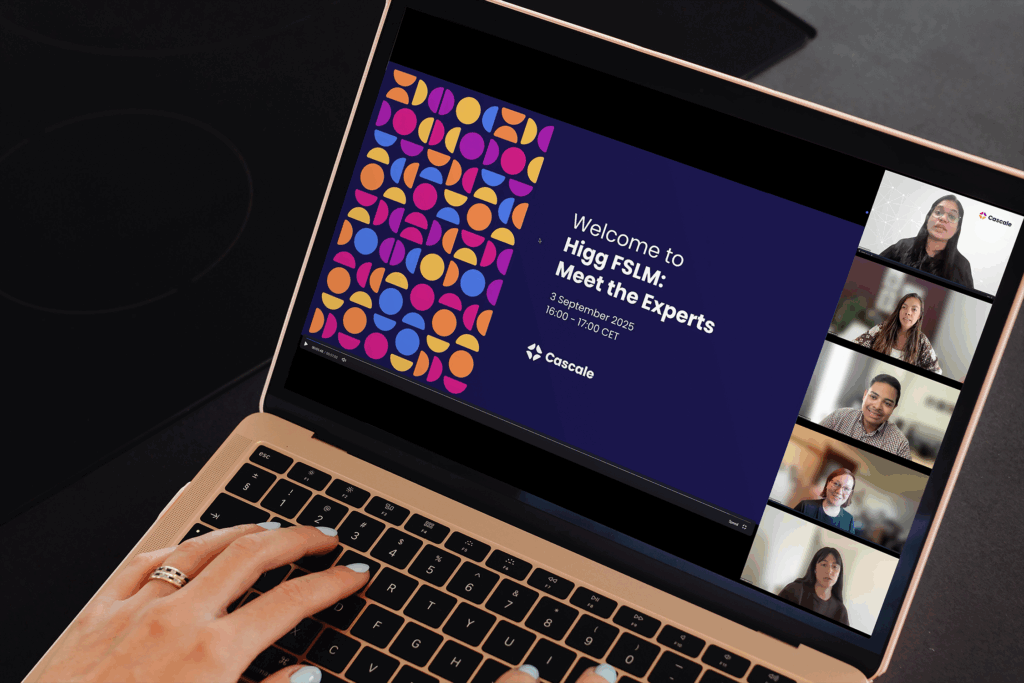
On September 3, Cascale welcomed more than 50 brand & retailer members and stakeholders to an exclusive Q&A webinar, Higg FSLM: Meet the Experts. The session offered a unique opportunity for members to engage directly with the experts behind the Higg Facility Social & Labor Module (Higg FSLM), part of the Higg Index suite of tools. The Higg Index — owned and developed by Cascale, and exclusively available on Worldly — helps brands, retailers, and manufacturers understand and improve performance across environmental and social impact areas, and the Higg FSLM specifically focuses on measuring and improving social and labor conditions in global supply chains.

The webinar was hosted by Hamza Habib Hasan, senior membership engagement manager for brand & retailer membership at Cascale, and featured presentations from:

  • Orine Dsouza, senior manager, Higg Facility Tools, Cascale
  • Laura Jans, customer growth manager, SLCP
  • Camille Stripoli, stakeholder engagement & partnerships manager, SLCP
  • Leah Jaggars, senior manager, customer education, Worldly

Together, they explained how the Higg FSLM is powered by a tripartite collaboration:

  • SLCP develops and maintains the Converged Assessment Framework (CAF), the foundation of the Higg FSLM, to collect and verify social and labor data with the goal of reducing audit fatigue.
  • Cascale integrates the CAF into the Higg FSLM, providing the scoring methodology and benchmarking tools that drive continuous improvement.
  • Worldly hosts the technology platform that makes it possible to complete the Higg FSLM and enables supply chain collaboration.

Experts shared how the Higg FSLM’s standardized scoring methodologies support facilities and brands to identify and prioritize risk more effectively. Dsouza also highlighted how tool developments are accelerated through the work of Cascale’s Member Expert Teams (METs) and Strategic Councils — governance bodies that bring together member perspectives to ensure industry alignment and practical usability of the tools.

This was followed by a deep dive into the SLCP CAF, which emphasized SLCP’s ongoing commitment to aligning the framework with human rights due diligence (HRDD) requirements. Members also heard updates on data availability, with CAF now accessible in 122 countries and regions, and were directed to key resources from all three organizations to support adoption and use.

The event concluded with a candid Q&A session, where members clarified the methodology, gained a deeper understanding of the scoring system, and shared feedback with the organizations leading this work.

This webinar reflects Cascale’s ongoing commitment to support members with opportunities to connect directly with experts, gain clarity on industry-leading tools like the Higg FSLM, and share feedback that helps shape future developments. By creating spaces for education and dialogue, Cascale strengthens member capacity to adopt solutions that reduce duplication, improve data quality, and accelerate progress on social and labor priorities.

Cascale members may access the session recording and summary on Cascale Connect here.

Higg FSLM CAF v1.7 Webinar

A public webinar focused on the Higg Facility Social & Labor Module (Higg FSLM) CAF v1.7 updates.

Date & Time
April 10 2025 | 10:00 - 11:00 (CEST)

Using the Higg Index to Trace Environmental Impact Results as We Drive Towards More Sustainable Textile Production

  • Higg FEM
  • Higg FSLM
higg-fem-global-fashion-fund-gemma-blog
Gemma-Verhoeven-good-fashion-fund
Gemma Verhoeven
March 10, 2023

Current fashion supply chains are highly polluting and wasteful, making the fashion industry one of the most unsustainable industries. In order to measure and quantify the sustainability impacts of a manufacturing facility, the SAC’s Higg Facility Environmental Module (FEM) is a valuable tool. The Higg FEM offers standardized measurements for sustainability and helps manufacturers, brands, and retailers identify and prioritize opportunities for performance improvements through the use of a common language.

However, acting on the data can sometimes be a financial challenge for manufacturers. Although sustainable technology solutions exist today, manufacturers often lack the knowledge or capital to invest in such machinery to improve their production processes. The Good Fashion Fund (GFF), a first-of-its-kind initiative by Laudes Foundation, was established to create systemic change in the textile and apparel industry by encouraging mainstream uptake of impactful and disruptive production technologies. The fund provides long-term USD loans to apparel and textile manufacturers in India and Bangladesh to enable them to implement innovative and sustainable technologies.

The first loan by the GFF was made to Pratibha Syntex in 2021. By the first monitoring visit in November 2022, the impact results surpassed the targets of a minimum of 50% savings. At the end of 2022, another loan was signed with Progress Apparels in Dhaka, and the GFF expects to close three more loans—one in Bangladesh and two in India—by the end of the quarter. The investments are diverse and relate to the enhancement of effluent treatment plants, the adaptation of state-of-the-art spinning and weaving equipment, the installation or replacement of washing unit equipment, and the expansion of unique waste-to-yarn recycling facilities.

The technology we finance relates primarily to equipment for dyeing, washing, printing, and wastewater treatment and reduces the use of hazardous chemicals, water, or energy in the production process. Every GFF investment should lead to a minimum of 50% reduction in consumption of one of our three environmental goods: Good Energy, Good Water, or Good Materials (incl. chemicals).

The GFF is unique in its focus on sustainable and ethical fashion and we’re proud to be the first financial investor to join the SAC’s global membership, utilizing the Higg FEM as a key part of our environmental due diligence process. The Higg FEM measures the exact environmental impacts of a facility’s operations that we aim to improve, such as water use, energy consumption, greenhouse gas emissions, waste management, and chemical management. It aligns perfectly with the GFF’s objectives.

In particular, the Higg FEM assesses a facility’s overall Environmental Management Systems and specifically gathers data on energy use, greenhouse gas emissions, water use, wastewater, air emissions, waste management, and chemical management. The score not only reflects absolute levels but particularly focuses on encouraging improvements and setting baseline levels and targets.

Having a verified Higg FEM score allows us at the GFF to limit our environmental due diligence efforts to desktop research and interviews conducted by our advisors Sphera and TUV Rheinland. When a facility is new to the Higg Index, our due diligence is more extensive and includes a site visit, but, ultimately, the manufacturers and operators in which we invest must receive a verified Higg FEM score. This allows the company to create value from the exercise and publicly communicate the results.

It is a complex analysis and will require continuous development. We are confident the SAC will maintain and leverage its close partnership with its member retailers, brands, manufacturers, and other stakeholders to continue improving and increase levels of adoption.

Moreover, the GFF uses the Higg FEM score, not only for the initial investment decision but also to better monitor continuous performance over the lifetime of our partnership with the manufacturer. As the Higg Index becomes more widely recognized and adopted, we will be able to more effectively communicate the sustainability performance of the portfolio companies to our investors. More importantly, it will help the manufacturers communicate their improved sustainability performance to consumers. The investments funded by the GFF typically improve a facility’s Higg FEM score substantially.

Our partner at TUV Rheinland, Rakesh Vazirani, Global Head of Sustainability Services, Consumer Products, noted: “Every facility we encounter for environmental due diligence is eager to make improvements to positively impact its environmental performance KPIs/metrics to showcase its progress, to explore cost savings, to highlight its uniqueness to customers, and to prepare for future regulation. Relying on existing industry frameworks like Higg FEM allowed facilities’ performance to be measured based on a harmonized framework; and GFF’s approach to fund improvements to make an impact fit into the wider mission of factories, local governments, and brands. We look forward to the continuous evolution of the Enhanced Due Diligence (EDD) framework to add efficiency to the process, and further alignment with European Green Finance taxonomy.“

Of course, the assessment and improvement of working conditions and labour rights are equally important aspects of the GGF’s objectives. Currently, the social due diligence is being performed by Fairwear Foundation, and important topics such as labor policies, health and safety conditions, workers committees, adequate administration and execution of contracts, salary management and working hours, grievance mechanisms, and anti-discrimination policies are being reviewed on site. In one of the more recent transactions, for the first time, the social due diligence included assessing the company’s verified scores of the Higg Facility Social & Labor Module (FSLM). Given social audits are at least as intensive for a company to accommodate as the environmental due diligence, we are exploring the possibilities of the Higg FSLM verification as more brands and manufacturers adopt the standard.

The GFF is dedicated to creating systemic change in the fashion industry, not only by the direct impact of its investments but also by sharing experiences and lessons learned widely. We aim to create partnerships with other actors in the fashion industry and financial sector, drive awareness of opportunities for sustainable technologies, and catalyze finance. GFF will continue to report on its investee companies extensively, encouraging further use of standardized measurements including the Higg FEM and Higg FSLM scores.


Higg Index Brochure

  • Higg Index Tools

Learn more about the business value and benefits of the Higg Index.

Higg Index brochure cover
September 04, 2021