
At High Point, SFC Marks 20 Years
Cascale and the Sustainable Furnishings Council (SFC) will celebrate two decades of industry leadership and the next chapter of home furnishings sustainability at High Point Market.
October 01, 2026
Produced by the apparel alliance – Apparel Impact Institute, Cascale, Textile Exchange, and ZDHC Foundation – the revised framework delivers consistency, transparency, and collaboration across the textile, clothing, leather, and footwear sectors.
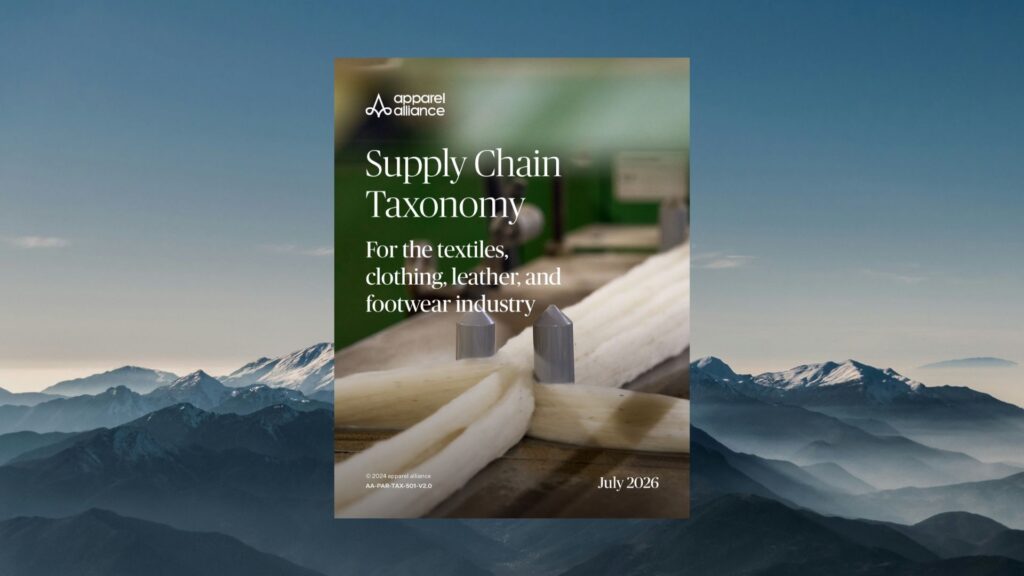
Produced by the apparel alliance – Apparel Impact Institute, Cascale, Textile Exchange, and ZDHC Foundation – the revised framework delivers consistency, transparency, and collaboration across the textile, clothing, leather, and footwear sectors.
Amsterdam, Hong Kong, Oakland (CA) — July 14, 2026: The apparel alliance (Apparel Impact Institute, Cascale, Textile Exchange, and ZDHC Foundation) today announced the launch of Version 2 of the Supply Chain Taxonomy, an updated harmonized framework designed to improve consistency, transparency, and collaboration across the textile, clothing, leather, and footwear (TCLF) sectors of the broader apparel industry.
“Shared definitions are not just administrative; they help the industry make better decisions, improve data quality, and work from the same understanding of the supply chain. Clarifying that wet processing is accounted for across all tiers, not just Tier 2, gives the industry a more accurate picture of where emissions sit and where action is needed most.” — Alma Palacios, senior sustainability reporting coordinator at Aii
“When facilities, products, and processes are classified consistently, the whole industry benefits, from more reliable data and clearer reporting to stronger collaboration on the work that matters most. The updated Supply Chain Taxonomy is foundational infrastructure for a more aligned and effective sustainability ecosystem. It reflects what’s possible when organizations commit to alignment, and we’re confident it will support more effective progress across the value chain.” — Joël Mertens, director of environmental impact methodologies at Cascale
“Aligning on a shared language for the supply chain is fundamental to driving credible, system-wide progress. This updated taxonomy helps bring greater clarity and consistency to how materials, processes, and impacts are understood and reported, enabling more effective collaboration and accelerating the industry’s transition to preferred production systems.”— Luca Mosca, director of impact data and reporting at Textile Exchange
“No single organisation can drive industry transformation alone. Shared language is a crucial foundation to enable collaboration within the ecosystem of like-minded partners. Bringing more depth to the Supply Chain Taxonomy with this new update strengthens the common foundation of the apparel alliance to enhance clarity for the wider value chain actors as well as unlock new opportunities to create a more interoperable system.” — Maria Arroyo, sector partnership lead at ZDHC
Building on its initial release in November 2024, the updated taxonomy addresses key challenges in the original framework, including overlapping processes, undefined boundaries, and classification gaps. The result is a clearer, more detailed structure that supports consistent classifications across the TCLF value chain and future alignment across apparel alliance work and joint initiatives.
The Supply Chain Taxonomy supports the apparel industry by:
The Supply Chain Taxonomy is a jointly developed and maintained resource of the apparel alliance organizations (Apparel Impact Institute, Cascale, Textile Exchange, and ZDHC). Designed as an evolving framework, planned annual updates reflect stakeholder feedback, emerging materials and technologies, and ongoing regulatory and industry developments. While not exhaustive, the taxonomy provides a practical foundation for classifying the most common processes and products across the value chain.
ABOUT THE apparel alliance
The apparel alliance is a collaborative industry working group uniting four global organizations: Apparel Impact Institute, Cascale, Textile Exchange, and ZDHC Foundation. Since its inception in 2020, the apparel alliance has worked to align sustainability tools, programs, and industry initiatives while reducing duplicative efforts across the apparel and textile sector. By combining complementary expertise, global networks, and shared goals, the apparel alliance aims to accelerate industry decarbonization and achieve a minimum 45% reduction in greenhouse gas emissions by 2030 across the global supply chain.
ABOUT Aii
Apparel Impact Institute (Aii) is a nonprofit collective founded in 2017 by four industry leaders: the Sustainable Apparel Coalition (SAC), the Sustainable Trade Initiative (IDH), Natural Resource Defense Council (NRDC) and Target Corporation. The organization emerged organically as a result of a real need that apparel brands and retailers self-identified. Gap Inc., PVH, Arvind Mills, HSBC, GIZ, Stichting Doen and Schmidt Family Foundation joined the founders in the first three years of start-up and organizational development. Aii identifies, funds, and scales proven quality solutions to accelerate positive impact in the apparel and footwear industry. Aii programs focus on areas that result in positive environmental impact from the production of apparel and footwear products to improve the industry.
ABOUT CASCALE
Cascale is the global nonprofit alliance driving systemic transformation to combat climate change and support decent work in the consumer goods industry. Formerly the Sustainable Apparel Coalition, Cascale unites a diverse, worldwide ecosystem of over 300 retailer, brand, manufacturer, supplier, service provider, government, academic, and nonprofit members.
Our alliance catalyzes pre-competitive collaboration for maximum impact, anchored by our stewardship of the Higg Index frameworks — implemented through the Worldly technology platform — and recent acquisition of the Better Buying and Sustainable Furnishings Council tools. While these methodologies are central to our work, they are part of a broader strategy to mobilize collective action, challenge industry norms, and build an industry that gives back more than it takes to the planet and its people.
Cascale Media Contact: Forster Communications, cascaleforster@forster.co.uk
ABOUT TEXTILE EXCHANGE
Textile Exchange is a global non-profit driving beneficial impacts on climate and nature across the fashion, textile, and apparel industry. It guides a growing community of brands, manufacturers, and farmers towards more purposeful production from the very start of the supply chain.
Its goal is to help the industry to achieve a 45% reduction in the emissions that come from producing fibers and raw materials by 2030, while keeping its focus holistic and interconnected and seeking to improve the state of our freshwater, soil health, and biodiversity too.
For real change to happen, everyone needs a clear path to beneficial impact. That’s why Textile Exchange believes that approachable, step-by-step instruction paired with collective action can change the system to make preferred materials and fibers the accessible default, mobilizing leaders through attainable strategies, proven solutions and a driven community.
At Textile Exchange, materials matter. To learn more, visit TextileExchange.org.
ABOUT ZDHC
The ZDHC Foundation oversees the implementation of the Roadmap to Zero Programme and is a global multi-stakeholder initiative of more than 350 Signatories within the fashion and footwear industry. Its vision is widespread implementation of sustainable chemistry, driving innovations and best practices to protect consumers, workers, and the environment. ZDHC uses collaborative engagement to drive a holistic, industry-focused and practical approach to sustainable chemical management. ZDHC guidelines, platforms and solutions drive large-scale industry-wide implementation that advances the industry as a whole towards the zero discharge of hazardous chemicals.
Cascale and the Sustainable Furnishings Council (SFC) will celebrate two decades of industry leadership and the next chapter of home furnishings sustainability at High Point Market.

Apparel sustainability veteran with 15+ years across brands, manufacturers, and consulting will lead Cascale’s work with manufacturers on climate action and decent work.
Yale students will work directly with the Higg Index, the sustainability impact measurement framework used across 45,000+ facilities worldwide, before entering the workforce.