
Specific Rules
Provides tailored rules for 13 product types — including t-shirts, dresses, jeans, boots, and more — to ensure relevant, consistent assessments across categories
Approved by the European Commission in 2025, the PEFCR for Apparel & Footwear provides a common language for measuring product-level environmental impact. Cascale served as coordinator of the Technical Secretariat that developed this official EU methodology — bringing together stakeholders across the value chain to ensure scientific integrity and industry alignment.

What is the PEF Methodology?
The Product Environmental Footprint (PEF) is a scientifically validated life cycle assessment (LCA) methodology to measure the relevant environmental impacts of products (goods or services) across their full life cycle. It builds on existing approaches and international standards and is part of the “Single Market for Green Products Initiative,” initiated by the European Commission.
The aim of the PEF is to provide a credible, harmonized framework for calculating a product’s environmental footprint. Central to the method are the Product Environmental Footprint Category Rules (PEFCR) — sector-specific rule sets that ensure consistent, transparent, and comparable results.
By defining a common approach across the industry, the PEFCR for apparel and footwear sets the basis for verified and trustworthy sustainability claims, in order to prevent greenwashing from companies. It allows for better reproduction and comparability of results by ensuring that all assessments are based on the same rules — a necessary condition for meaningful environmental communication.

Cascale’s Role in PEFCR Development
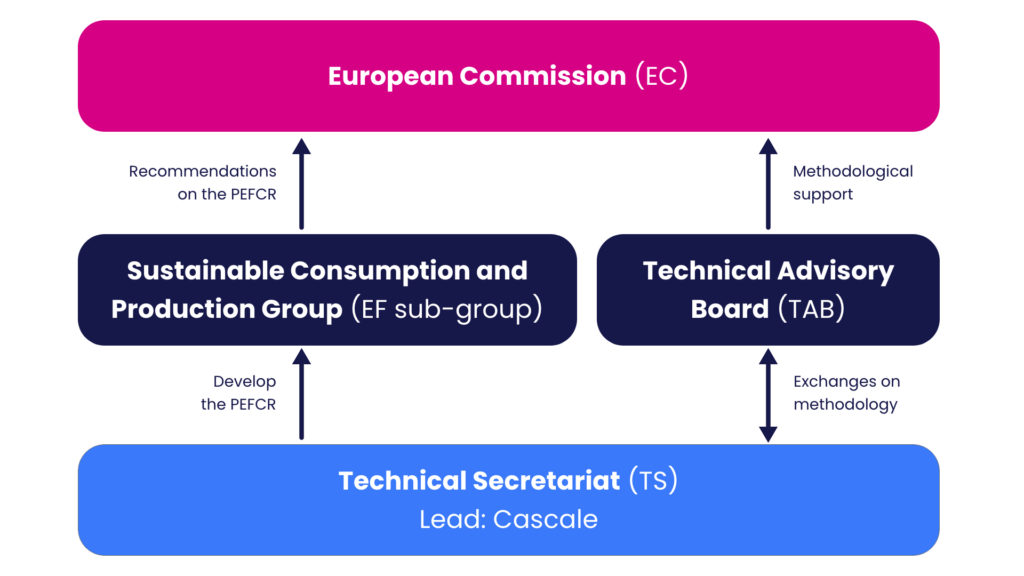
In 2019, Cascale responded to a request from the European Commission and was selected to serve as the coordinator for the Technical Secretariat (TS) to develop the Product Environmental Footprint Category Rules (PEFCR) for the apparel and footwear sector. This involved convening a collaborative, multi-stakeholder working group representing diverse perspectives from across the industry — including brands, manufacturers, fiber suppliers, NGOs, academics, and civil society — with the shared task of developing a science-based, policy-ready methodology for product-level environmental impact assessment in the EU.
While Cascale coordinated the TS, we were not the sole contributors. We facilitated a process grounded in transparency and inclusivity, and also participated as technical experts, holding an equal voice alongside other TS members.
The approach reflects Cascale’s strength as an industry convener, capable of aligning industry, civil society, and policy perspectives around shared sustainability goals.
The objective of our role is to ensure that the PEFCRs are scalable, drive change, and ultimately reduce the impacts of the apparel and footwear sector as a whole.
By collaborating with policymakers, stakeholders, and partners such as Policy Hub – Circularity for Apparel & Footwear, Cascale continues to advocate for and support the alignment of industry tools with formal regulatory frameworks — helping the industry prepare for the transition from ambition to accountability.
Who is Involved
The PEFCR for Apparel & Footwear was developed through a multi-stakeholder process coordinated by Cascale as the Technical Secretariat coordinator, with active participation from across the value chain.

Why Cascale Was Selected to Lead
A key requirement for any group of organizations to form a technical secretariat is their ability to gather at least 50% of any given industry. With more than a decade of experience working across brands, manufacturers, retailers, and fiber producers, Cascale was uniquely positioned to convene a balanced and credible coalition of stakeholders.
As an organization, one of Cascale’s core objectives is to unite the industry around a common language in sustainability performance and measurement, which mirrors the goal of the PEFCR. We believe policy must build on existing initiatives like the OECD Guidelines, UNGPs, and Cascale’s Higg Index, to avoid duplication and to accelerate industry-wide change.
Well-informed and well-structured policy can help the industry comply quickly and accurately, which is one of the reasons we co-founded the Policy Hub, together with the Global Fashion Agenda and the Federation of the European Sporting Goods Industry (FESI), to enable the sector to speak with one voice as it informs the development of regulation.
Organizational Structure
Why the PEFCR Matters for Apparel & Footwear
Approved by the European Commission in June 2025, the Apparel & Footwear PEFCR is a significant milestone for sustainability in the consumer goods sector. The PEFCR offers a common, credible foundation for measuring product-level environmental impacts — supporting both industry alignment and EU regulatory compliance.
The PEFCR delivers five key benefits for the industry:
Provides tailored rules for 13 product types — including t-shirts, dresses, jeans, boots, and more — to ensure relevant, consistent assessments across categories
Enables meaningful comparisons between similar products by improving consistency across environmental claims and performance metrics
Streamlines data and modeling through standardized assumptions, helping reduce time and cost, particularly for SMEs
Incorporates durability and repairability metrics, guiding innovation and product development toward lower-impact design
Establishes a unified methodology across the EU market — enabling brands, manufacturers, and regulators to speak the same language when assessing environmental impact.
Supporting Implementation and Industry Alignment
The approval of the PEFCR is not the end of the process — it’s the beginning of implementation. Cascale is working closely with members, partners, and policymakers to help translate the methodology into practical application across the value chain.
A central part of this work is through the Higg Product Module (Higg PM), which was released in June 2021 to enable environmental assessment of a product’s impacts over its full life cycle through end-of-use. Developed through collaboration with our membership, including brands, manufacturers, academics, and non-governmental organizations, the Higg PM was also informed by our prior leadership in shaping a draft Footwear PEFCR.
Much of that foundational work has directly influenced the final methodology. The current version of the Higg PM already captures many of the critical data inputs required by the PEFCR, such as material composition, processing impacts, and product durability. Companies using the Higg PM are often already collecting product-level data that aligns with the PEFCR — including key elements like Bill of Materials and process-specific assumptions.
Beyond tools alignment, Cascale works closely with EU institutions, national authorities, and like-minded organizations — such as those convened through Policy Hub — to advocate for legislation that is both scientifically sound and practically implementable. This work is grounded in the realities faced by our members across the value chain.
Ultimately, our goal is to bridge policy and practice, empowering the industry with the tools, data, and support needed to make sustainability claims that are credible and actionable.
Why This Work Matters
For our industry to be successful in solving systemic problems, fulfilling ambitious sustainability goals, and creating more respectful and secure work environments along the global value chain, alignment is essential — around priorities, methods, data, and claims. The PEFCR enables this alignment by providing a science-based and transparent approach to product impact measurement.
Cascale supports ambitious legislation because it will help us align around clear and common standards to create a consumer goods industry that gives more than it takes — to the planet and its people.
Explore Cascale & Worldly’s latest policy deep dive into what PEFCR and France’s Environmental Cost framework mean for apparel and footwear.
