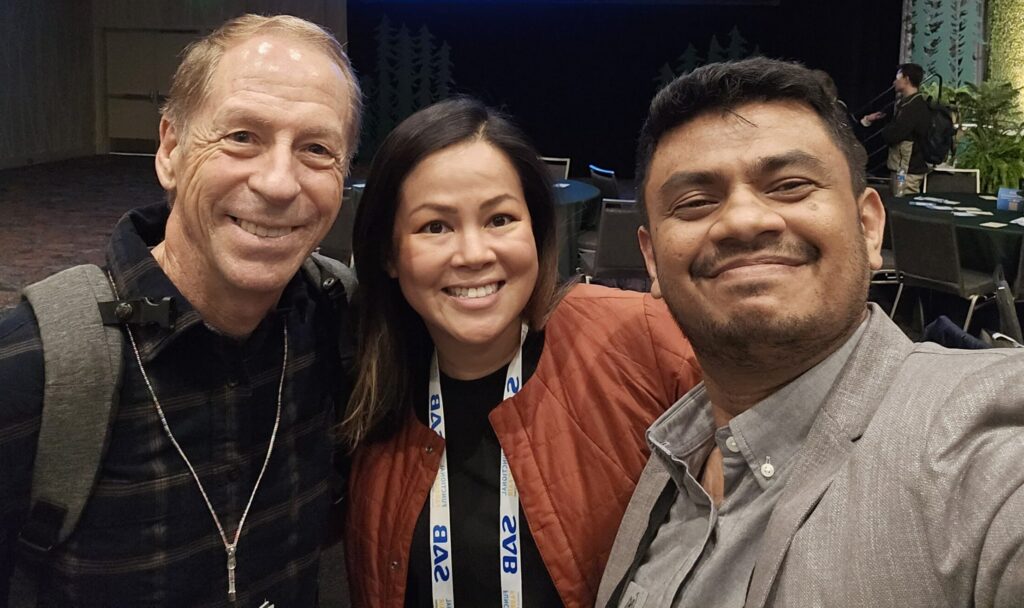
Cascale took part in the Outdoor Industry Association’s Catalyst Conference in Portland, Ore., October 26, leading a roundtable on forced labor compliance.
About 300 outdoor and sportswear professionals gathered in Portland for the Outdoor Industry Association’s (OIA) Catalyst Conference, a practitioner-led event on sustainability for the outdoor sector. Joleen Ong, senior director, brand and retailer member activation, at Cascale, represented the organization, facilitating a peer roundtable on forced labor regulation and joining a workshop on sustainability education.
Sessions focused on aligning commercial incentives with sustainability to reach 2030 targets, with practical guidance for small and midsize brands.
Making the Business Case for Sustainability
A standout session, “The Business Case: How to Win Budget and Buy-In for Sustainability,” featured Krishna Manda, global head of sustainability at Lenzing (also a Cascale member), and Ken Ratterree, chief financial officer of KEEN, on how sustainability and finance teams can work together.
Panelists described embedding sustainability directly into business planning. Lenzing evaluates every ESG project with a full business case, including capital and operating costs, internal rate of return, and payback, while KEEN uses its sustainability goals to frame its long-range plan. Speakers noted that quantifying climate risk, such as projected raw material cost increases, can justify investment in alternatives today.
Proof of success also unlocks capital. Lenzing’s results with its ECOVERO fibers helped move forward a long-stalled facility investment, followed by two more. Panelists encouraged brands to share the cost of cleaner production with their manufacturers, noting that co-creation works better than mandates, and to approach finance colleagues as thought partners, starting from a shared pain point rather than a pitch.
Navigating Forced Labor Regulation
At the peer workshop “Compliance in Practice: Navigating Sustainability Regulations,” Cascale led the forced labor roundtable with consultant Motthida Chin, sharing an overview of the evolving regulatory landscape. Topics included the EU Forced Labor Regulation, which applies to companies of all sizes and places the burden of proof on the company; enforcement of the U.S. Uyghur Forced Labor Prevention Act; and the challenges brands face in operating across jurisdictions with conflicting requirements.
For brands getting started, Cascale’s Ong recommended a country-focused approach, since many of the highest risks are predictable. Brands can use social and labor monitoring data, such as the Social and Labor Convergence Program (SLCP) assessments and the Higg Facility Social & Labor Module (Higg FSLM), to inform supplier pre-screening, with particular attention to recruitment fees and migrant workers. Because companies must be able to demonstrate their supply chains are free of forced labor, brands should also prepare to close traceability gaps.