Fast Retailing convened media, industry experts, and collaborators in London and New York City for annual media events focused on the group’s sustainability efforts.
In London, approximately 20 journalists from trade, business, and international media gathered in London recently for the event, moderated by fashion sustainability voice Rachel Arthur, to explore the role of long-term partnerships, supply chain visibility, decarbonization, and circularity in advancing sustainability across the apparel value chain.
Opening the event, Taku Morikawa, chief executive officer of UNIQLO Europe, reflected on a recent visit to Moldova, where the company works with the UN Refugee Agency (UNHCR) and other international NGOs to provide emergency clothing relief for Ukrainian refugees. The event then moved into a broader discussion of Fast Retailing’s sustainability strategy, led by Odilia d’Aramon-Guepin, corporate PR and sustainability director, UNIQLO Europe.
D’Aramon-Guepin shared progress against the company’s climate goals, including a reported 90 percent reduction in Scope 1 and 2 emissions across its own operations. She also highlighted Fast Retailing’s decision to increase its Scope 3 emissions reduction target from 20 percent to 30 percent by 2030, reflecting the company’s ambition to drive greater impact across its supply chain.
A common thread throughout the presentation was the importance of long-term supplier relationships. Many of Fast Retailing’s manufacturing partners have worked with the company for decades, creating the trust and stability needed to support investments in sustainability improvements.
That theme continued during a panel discussion on supply chain decarbonization featuring Kazumi Yanai, group senior executive officer at Fast Retailing, and Lee Green, vice president, marketing, communications & public affairs at Cascale.
Panelists highlighted fragmentation and supply chain complexity as major barriers to progress where oftentimes suppliers serve multiple customers with duplicate demands.
“Most emissions sit in the supply chain, not in a brand’s own operations,” said Green. “The question is no longer whether solutions exist. The question is how we create the conditions that allow them to scale.”
Drawing on insights from Cascale’s Better Buying program, Green emphasized the role that commercial relationships play in enabling sustainability progress. “Long-term relationships create something incredibly important: predictability,” he said. “Suppliers will invest if the relationship itself is deemed investible.”
He noted that when manufacturers have confidence in future business, they are more willing to make long-term investments in renewable energy, cleaner technologies, and operational improvements.
Yanai shared how its long-standing supplier partnerships have supported investments in energy efficiency, renewable energy, and other emissions reduction initiatives, helping build confidence in the company’s ability to strengthen its Scope 3 targets.
The event also explored the growing importance of traceability and responsible sourcing. A discussion featuring Tomoya Utsuno, director (Materials), production department at Fast Retailing, and sustainable fashion journalist and consultant Megan Doyle examined how brands are working to gain greater visibility into their supply chains.
The final discussion focused on circularity and Fast Retailing’s collaboration with Central Saint Martins. Maria Ledous, Sustainability Manager at UNIQLO Europe Limited, and graduate designer Haseeb Hassan shared how the partnership challenged students to transform returned UNIQLO garments into commercially viable products while remaining true to the company’s LifeWear philosophy.
The resulting “Everyday Reimagined” collection will be introduced through RE.UNIQLO Studio locations across Europe, providing an opportunity to explore how circular design concepts can be scaled in a retail environment.
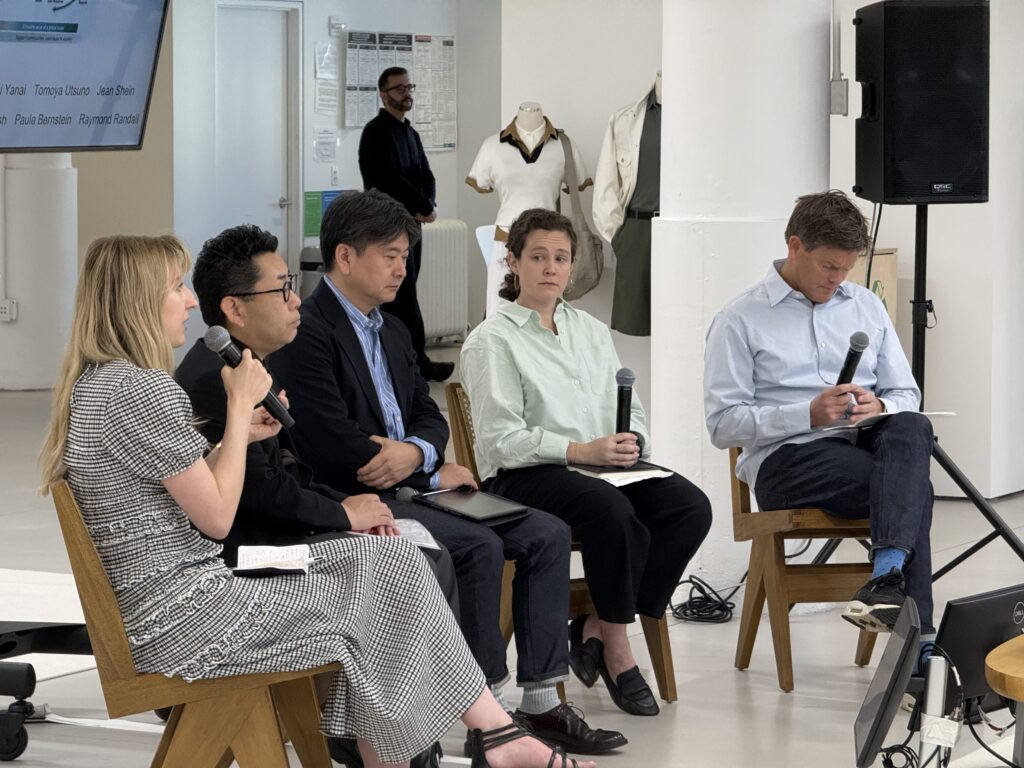
In the New York City programming, speakers similarly elevated the importance of Fast Retailing’s Scope 3 emissions reduction pathway, long-term supplier relationships, and innovative consumer-focused circular collaborations. Over 15 journalists and guests attended this intimate event.
Consultant Michael Sadowski moderated the sessions, joined by returning panelists Kazumi Yanai and Tomoya Utsuno from Fast Retailing. Cascale’s editorial director Kaley Roshitsh and Worldly’s Paula Bernstein, associate director of sustainability science, also contributed to sessions on emissions and traceability.
In highlighting the group’s emissions-reduction milestones, Fast Retailing’s Yanai stressed the necessity of “meeting commitments together” with suppliers.
Roshitsh highlighted the mutual benefits of this approach. “The No. 1 thing [suppliers] want is commercial predictability. That comes from long-term relationships where you know what order volume is coming.”
In the next session, Fast Retailing’s Utsuno and Worldly’s Bernstein explained the benefits of traceability. Utsuno outlined efforts to build stronger relationships further upstream in its supply chain, supported by systems that provide visibility into Tier 3 suppliers and raw material origins.
He highlighted the Australian Merino wool initiative as an example of how direct engagement with upstream partners can support traceability, responsible sourcing, and product quality. Bernstein, meanwhile, emphasized that a traceable supply chain is a resilient one.
In the final panel, Waste Management’s head of sustainability growth solutions Raymond Randall and Jean Emmanuel Shein, sustainability director at Uniqlo USA, spoke on a unique collaboration tackling waste at the point of item departure: the dreaded apartment move.
The collaboration between Uniqlo, Piece of Cake Moving and Storage, and Waste Management is called UNTRASH IT, and similarly, followed years of relationship-building.
The panelists touted the ease of the initiative with Uniqlo’s Shein joking about the importance of the “smell test” in determining an item’s next useful life. The collaboration foresees expansion plans outside of New York City into Dallas and Los Angeles.
Across both events, a common conclusion emerged. Whether addressing decarbonization, traceability, or circularity, progress depends on trust, collaboration, and the confidence to invest in long-term change. As one networking attendee remarked, “Why don’t more brands present like this?”